
Thai SMEs Face China Import Pressure—Why Adding Value May Be the Way Forward

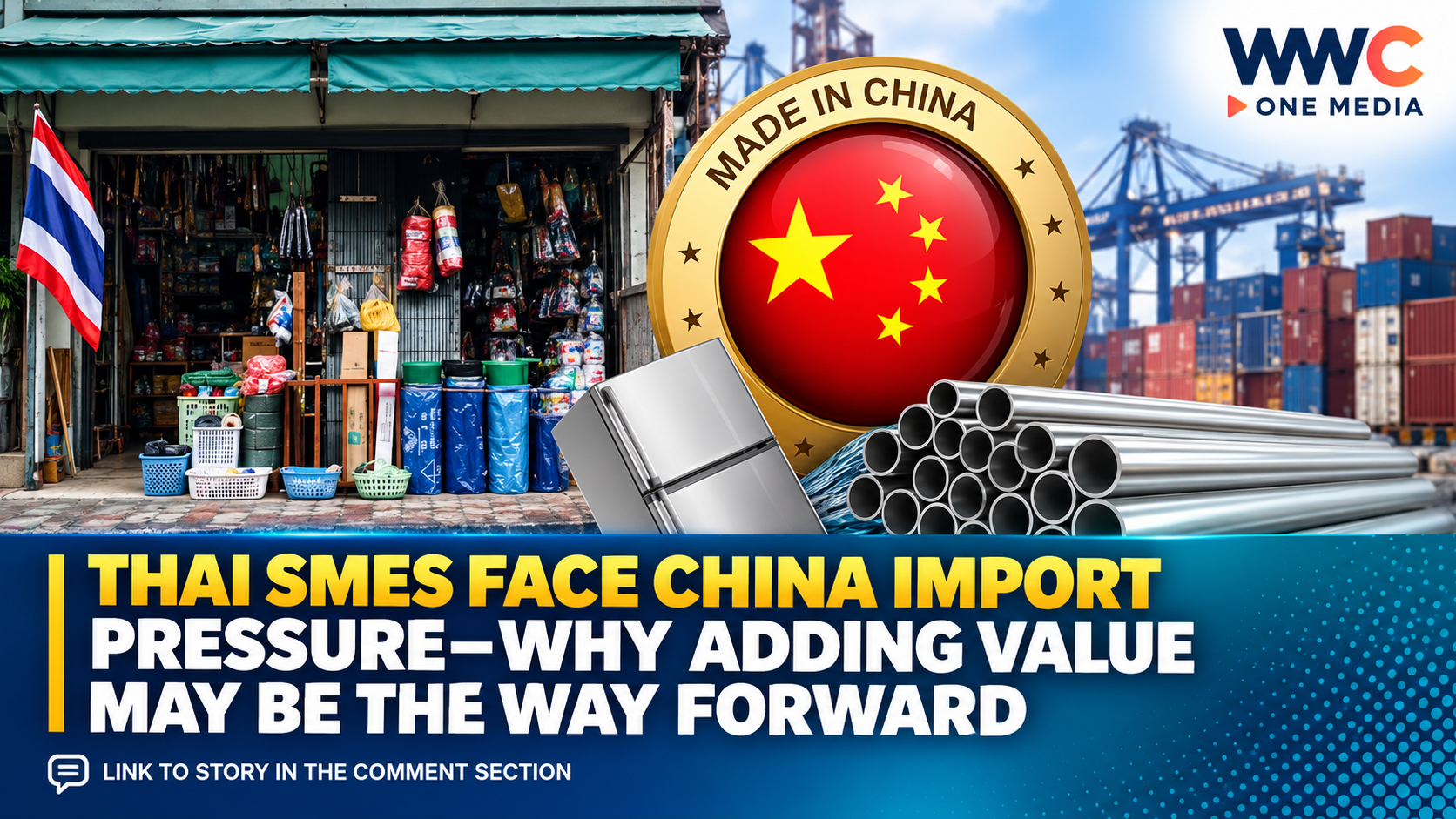
Thailand’s small businesses are facing an increasingly difficult battle against cheaper Chinese imports—but officials and trade experts say trying to compete on price alone could be the wrong strategy.
Instead, Thai small and medium-sized enterprises may need to move in the opposite direction: create products with higher value, stronger brands, better technology and greater differentiation.
The warning comes as Thailand's trade imbalance with China continues to widen and Chinese products gain ground across Southeast Asian markets.
The issue is becoming increasingly urgent for Thai SMEs, which operate with considerably less scale and financial firepower than many Chinese manufacturers.
Thailand cannot simply out-price China
Chinese manufacturers benefit from enormous production scale, integrated supply chains and highly competitive costs.
That makes a direct price war particularly difficult for smaller Thai businesses.
Recent EXIM Thailand research shows just how quickly Chinese competition is changing the regional market. Thai SME exports to ASEAN have become more vulnerable as Chinese producers expand their presence, with China benefiting from economies of scale and excess production capacity.
In plastic products, for example, China's share of the ASEAN market increased from 27% in 2021 to 39% in 2025, according to the research. China's share of ASEAN trade in iron and steel products also rose from 46% to 59% over the same period.
For a small Thai manufacturer, attempting to beat those producers by simply lowering prices could be a race to the bottom.
The alternative is to make the product harder to compare on price alone.
The China trade gap is getting harder to ignore
The pressure is visible in Thailand's trade figures.
In the first seven months of 2026, Thailand's trade deficit with China reached approximately US$55.13 billion, up 59.31% from a year earlier, according to figures reported by The Nation.
Imports from China jumped 38.49%, while Thai exports to China increased only 9.17%. Electrical machinery and components were among the biggest drivers, with imports in that category rising 83%.
The imbalance is not entirely the result of consumer products competing with Thai businesses.
Some imports from China are machinery, components and intermediate goods used by factories—including businesses connected to Chinese investment in Thailand.
That distinction matters.
A rise in imports does not automatically mean Chinese products are destroying Thai manufacturing. Some imported machinery and components can actually help Thai companies become more productive.
The problem arises when imported finished goods increasingly replace domestic production without creating comparable value inside Thailand.
Thai SMEs are growing—but the structure is worrying
There is another twist to the story.
Thai SME exports have actually been performing strongly.
EXIM Thailand's latest analysis found that Thai SME exports grew by more than 37% during the first five months of 2026, more than twice the growth rate of overall Thai exports. Even excluding gold, SME exports were up more than 32%.
That sounds like good news.
But underneath the headline numbers, EXIM Thailand identified structural weaknesses.
Thai SME exports remain concentrated in a relatively small number of markets, while imports have also surged. SME imports increased by more than 36% in 2025 and continued growing by around 39% in the first five months of 2026, according to the research.
China has become the largest source of imports for Thai SMEs, accounting for almost half of their imports, compared with less than 30% for large exporters.
That creates a paradox:
Thai SMEs can export more while simultaneously becoming more dependent on foreign supply chains.
If the imported content of those products rises while domestic value creation remains limited, stronger export numbers do not necessarily translate into equally strong gains for the Thai economy.
The real weapon: value, not volume
This is where the push for "value-added" products becomes critical.
Instead of selling products that can easily be copied and compared with cheaper Chinese alternatives, Thai businesses can compete through factors such as:
- Product design
- Branding
- Quality
- Food and agricultural processing
- Specialized manufacturing
- Local cultural identity
- Customer service
- Sustainability
- Digital technology
- Intellectual property
- Specialized niche markets
The objective is straightforward:
Make the product worth more than the raw materials and manufacturing cost used to produce it.
That could allow a Thai SME to charge a premium rather than trying to match the lowest price available in the market.
Technology could give smaller companies a fighting chance
Technology is increasingly becoming part of that equation.
A July 2026 report citing UOB's Business Outlook Study found that more than 70% of surveyed Thai SMEs were implementing AI, while more than 80% said they planned to expand overseas over the following two to three years.
AI can potentially help smaller companies with areas such as demand forecasting, marketing, customer service, inventory management, product development and administrative work.
But technology alone is not enough.
The real advantage comes when businesses use technology to change the economics of their operations—producing better products, reducing waste, improving productivity and reaching customers outside Thailand.
Thailand's SME problem is bigger than Chinese imports
Cheap Chinese products are only one part of the challenge.
Thai SMEs are also dealing with weaker domestic purchasing power, higher operating costs and tighter access to credit.
A recent Nation report cited a 2026 TMBThanachart Bank SME survey showing average SME sales declines of around 4–5%, while SME non-performing loans stood at 9.16% and SME lending had contracted for 15 consecutive quarters.
That means many businesses are being squeezed from both sides.
Their customers have less money to spend, while their own costs remain high.
At the same time, cheaper imports create additional pressure on selling prices.
For businesses already operating on thin margins, that combination can become extremely difficult to survive.
Thailand has already tightened rules on low-value imports
Bangkok has also taken steps to address the competitive imbalance.
Beginning January 1, 2026, Thailand ended its previous exemption for low-value imported goods and began applying VAT and customs duties from the first baht, with the government saying the move would create fairer competition for Thai businesses and reduce problems involving undervaluation and unusually cheap imports.
But trade policy cannot solve the entire problem.
Even with taxes and customs enforcement, Thai producers still have to compete against companies operating at enormous scale.
That is why productivity and product differentiation matter.
Thailand needs to move up the value chain
EXIM Thailand's research points to a broader issue: SMEs make up nearly 80% of Thailand's exporters but account for only around 10% of total export value, according to its structural analysis. Large companies represent roughly 20% of exporters but generate more than 90% of export value.
That imbalance suggests Thailand's challenge is not simply getting more SMEs to export.
It is getting more SMEs to export higher-value products at greater scale.
That means helping small businesses access technology, financing, international markets, intellectual property protection, modern production systems and global supply chains.
There is still an opportunity in the China challenge
The rise of Chinese competition does not necessarily mean Thailand has to lose.
In fact, stronger Chinese competition could force Thai companies to accelerate changes that have long been necessary.
Thailand still has major advantages in areas such as food, agriculture, tourism-linked products, wellness, medical services, creative industries and specialized manufacturing.
The country's task is to turn those advantages into products and services that cannot easily be replaced by a cheaper factory-made alternative.
A Thai food brand with a recognizable identity, premium ingredients and international certification is competing differently from a generic product.
A specialized Thai manufacturer producing a high-precision component is playing a different game from a commodity producer.
And a company using Thai culture, design or intellectual property to create a global brand is no longer competing solely on manufacturing cost.
The race is no longer just about who is cheapest
China's growing export presence has changed the competitive landscape across ASEAN.
But the answer for Thailand may not be to build a wall around its economy.
Thailand is deeply integrated into regional supply chains, and Chinese investment and imported machinery can also support production inside the country.
The bigger challenge is ensuring that this integration creates more value inside Thailand, rather than turning the country into primarily a market for imported finished goods.
That means connecting foreign investment with Thai suppliers, encouraging technology transfer, developing domestic capabilities and helping SMEs move into higher-value segments.
The choice facing Thai SMEs
The warning from officials and trade analysts ultimately points to a difficult choice.
Thai businesses can attempt to fight China's manufacturing giants on their strongest ground—price and scale.
Or they can compete somewhere China is harder to beat: brand, quality, specialization, innovation, design and value.
The first path could lead to increasingly thin margins.
The second requires investment, skills and patience—but it offers a much better chance of creating sustainable businesses.
Thailand's trade numbers show that the Chinese import challenge is already here.
The question now is whether Thai SMEs can transform that pressure into the push they need to become more valuable, more innovative and more competitive before the next wave of Chinese competition arrives.