
Thailand Moves to Expand Social Security to Farmers, Street Vendors and Domestic Workers — But One Major Step Still Remains

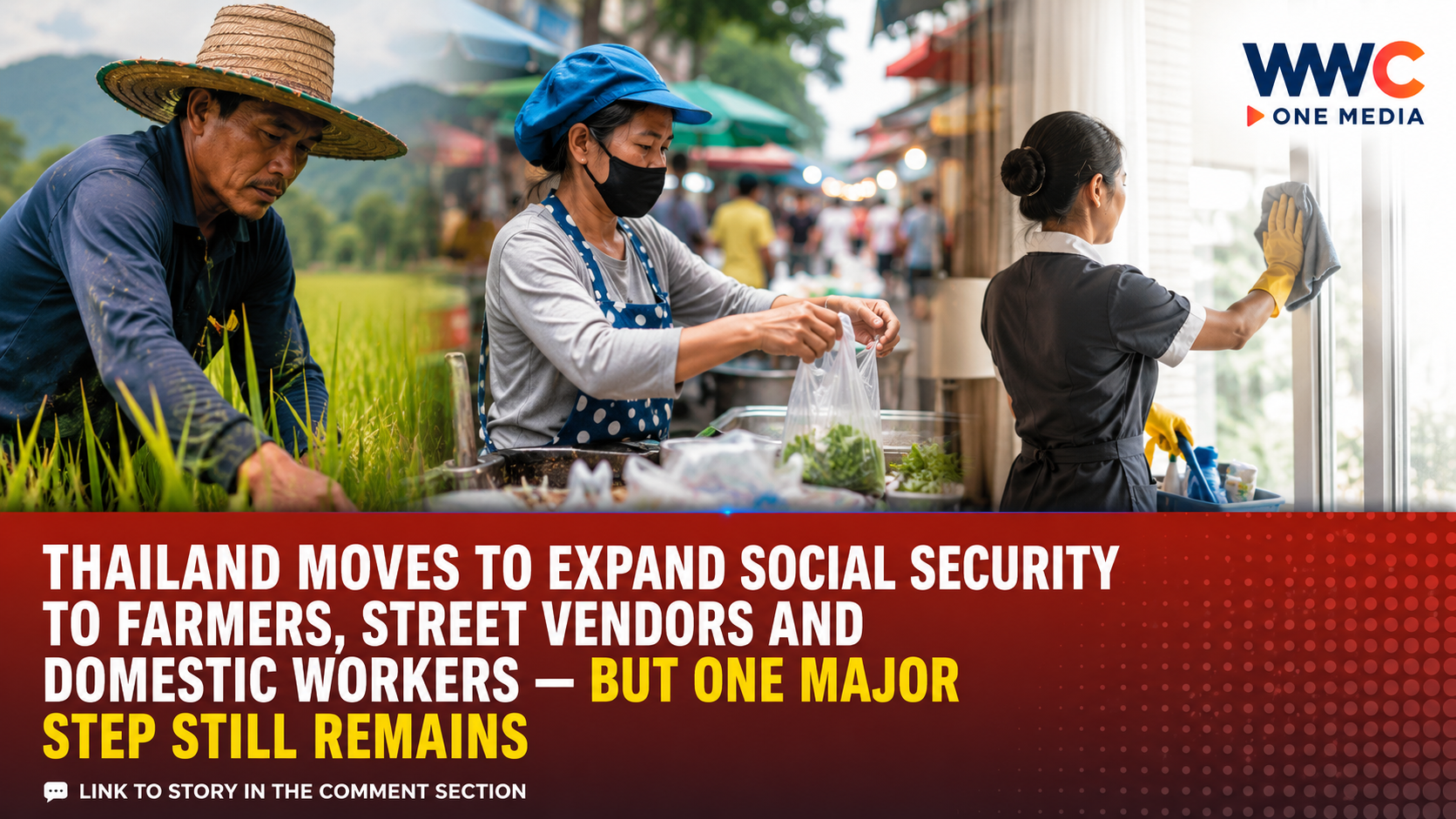
Thailand is moving toward a major expansion of social security protection that could bring previously excluded groups—including agricultural workers, street vendors and domestic workers—closer to the country’s formal social security system.
The Labour Ministry is preparing changes to extend Section 33 coverage under Thailand’s Social Security Act to workers in sectors that have historically faced gaps in employment-based protection. The proposal is part of a broader government effort to bring more informal and vulnerable workers into the social security system.
The development was reported by the Bangkok Post, while Thai government and international labour sources provide additional context on the scale and significance of the proposed reforms.
Who could be affected?
The proposed expansion focuses on several groups that have traditionally had limited access to compulsory social security coverage, including:
- Agricultural workers
- Street-vending workers
- Domestic workers
Thailand’s existing rules have left significant numbers of workers in these sectors outside Section 33 coverage, particularly where employment arrangements fall outside the traditional employer-employee model.
A recent Social Security priority and needs survey cited by the International Labour Organization found that about 13.6 million agricultural and fishery workers were not covered, representing roughly 95.6% of the sector. The survey also estimated that about 715,500 street vendors and 170,900 domestic workers were outside coverage.
That means the proposed reform could potentially affect a very large part of Thailand's workforce.
Why the proposal matters
For workers who qualify under Section 33, social security provides access to a range of protections, including benefits associated with sickness, maternity, disability, death, child support, old age and unemployment.
The reform therefore goes beyond simply adding names to a government register. It could give workers who have traditionally operated on the margins of Thailand's formal labour system a clearer path toward employment-based social protection.
The International Labour Organization has previously highlighted the difficulties faced by domestic workers in accessing employment-based social security in Thailand, noting that many remain outside the system because of the way domestic employment is legally structured.
Agriculture remains one of the biggest gaps
The scale of the agricultural sector's exclusion is particularly striking.
ILO data indicate that agriculture and fishery workers make up the largest identified group among people without social security coverage, with more than 13.6 million workers estimated to be outside coverage.
Street vendors also face a very high exclusion rate, with approximately 95% of workers in that category estimated to lack coverage. Domestic workers have an estimated non-coverage rate of nearly 90%.
These figures help explain why expanding social security to informal occupations has become an increasingly important policy issue in Thailand.
The proposal has been building for years
The latest move does not come out of nowhere.
Thailand has been discussing ways to strengthen protection for informal workers for years. In February 2025, the Social Security Office's tripartite management board agreed on amendments that included expanding Section 33 to temporary and seasonal migrant agricultural workers, street-vending workers and domestic workers. The proposed reforms also included gradually increasing the contribution ceiling.
Thailand's government has also previously acknowledged the need to improve protection for informal workers and domestic employees.
In February 2025, Thailand's Public Relations Department reported that the Social Security Office was preparing public consultation on expanding Section 33 coverage to three additional occupational groups: workers in agriculture, fisheries, forestry and animal husbandry; domestic employees hired by individual employers; and certain street-vending employees working at identifiable stalls under arrangements such as market or shopping-centre stall leases.
Important: the reform is not yet the same as immediate coverage
While the announcement is significant, workers should not assume that the new protection is already fully in effect.
The current development concerns proposed legal and regulatory changes. The government still has to complete the necessary legislative and administrative process before expanded Section 33 coverage can be implemented.
That distinction is important because headlines about "Thailand expanding social security" could otherwise be interpreted as meaning that every farmer, vendor or domestic worker can immediately register and receive full Section 33 benefits.
The actual eligibility rules, contribution requirements and implementation timetable will depend on the final legislation and regulations.
A broader push to close Thailand's labour-protection gaps
The social security proposal comes as Thailand's Labour Ministry pursues several reforms aimed at extending protection to workers outside traditional employment arrangements.
In August 2026, the Thai government announced Cabinet approval of four labour-related legal measures involving seafarers, homeworkers and employees of state enterprises. One measure would bring seafarers more directly under social security and workers' compensation laws, while another would strengthen protections for people receiving work to perform at home, including work obtained through online systems.
The government has also been working on protections for platform workers and riders, another group that has historically faced difficulties accessing conventional employment benefits.
Taken together, the measures point toward a broader policy shift: Thailand is attempting to make its labour-protection system fit a workforce that increasingly includes informal, temporary, self-employed and platform-based workers.
What happens next?
The key question now is when—and under what conditions—the expanded Section 33 coverage will actually take effect.
If the proposed changes become law, thousands or potentially millions of workers currently outside compulsory social security could gain access to a stronger safety net.
For farmers, street vendors and domestic workers, however, the most important details will ultimately be found in the final rules: who qualifies, who must contribute, how much workers and employers will pay, and when registration begins.
For now, the message is clear: Thailand is moving to close one of the country's longstanding social-security gaps—but the final implementation still matters.