
Thailand Tourism Slows as Foreign Arrivals Fall 2.91%—But the Bigger Warning May Be What Happens Next

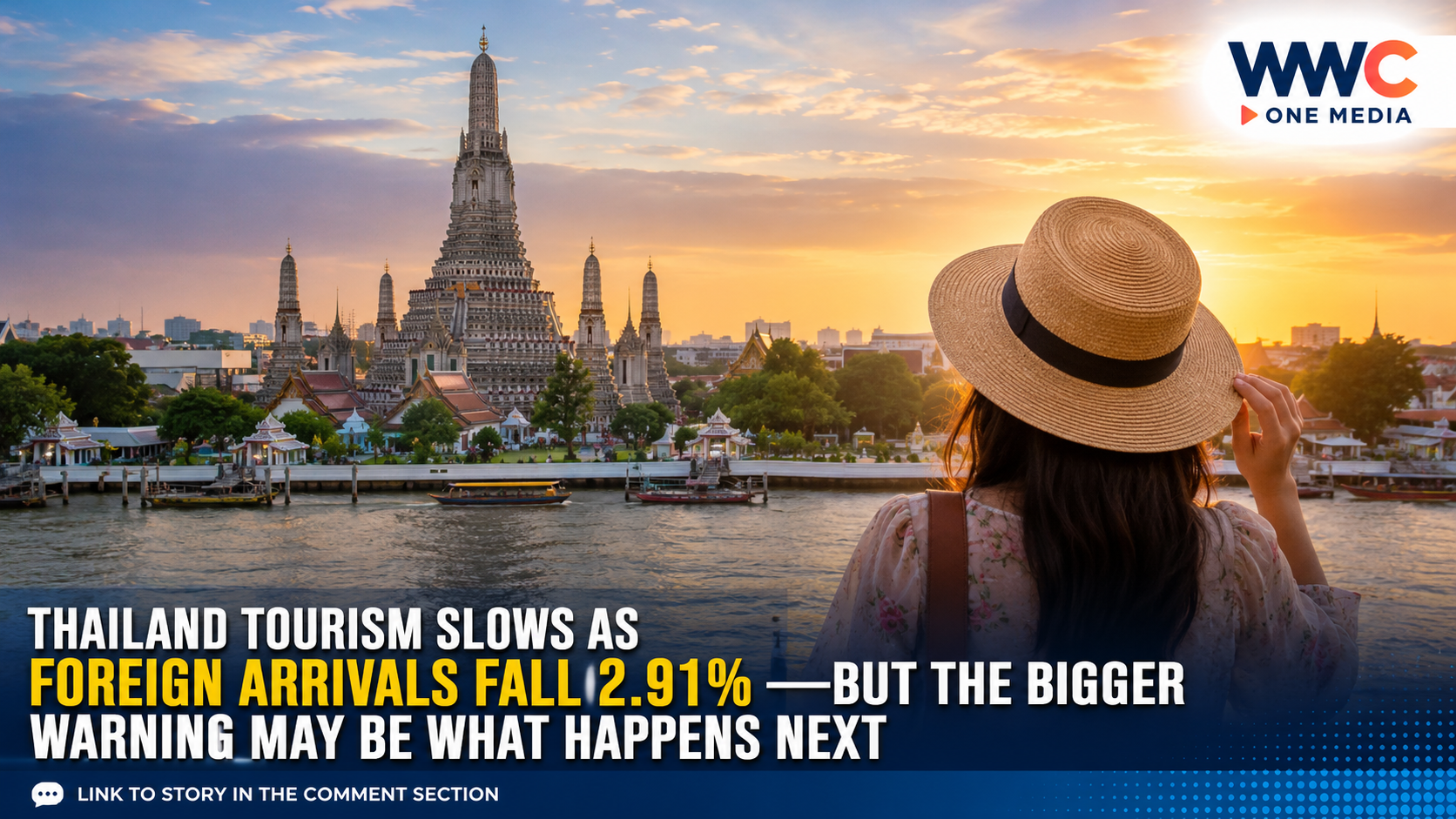
BANGKOK — Thailand’s tourism industry is facing another difficult stretch in 2026 as international visitor arrivals continue to trail last year’s levels, with geopolitical tensions, higher travel costs and weaker air connectivity weighing on demand.
Foreign tourist arrivals to Thailand fell 2.91% year on year from January 1 to August 8, 2026, according to figures cited by Thai PBS World and reported by Thai tourism authorities. Despite the decline, the government and tourism industry are still hoping for a stronger final quarter as the peak travel season approaches.
The slowdown is significant because tourism remains one of Thailand’s most important economic engines. The Bank of Thailand has also reported that tourism-related activity weakened in the second quarter, with foreign arrivals and tourism receipts affected by the conflict in the Middle East, higher energy costs and disruptions to air services.
Foreign arrivals remain below last year
The latest figures follow an already challenging start to the year.
Thailand recorded about 18.51 million foreign visitors between January 1 and August 1, down 3.19% from the same period in 2025, according to data reported by the Bangkok Post.
Reuters similarly reported that international arrivals were down around 3.2% year on year as of August 1, citing geopolitical uncertainty, higher travel costs and weaker purchasing power in some major source markets.
The weekly numbers have also shown periods of weakness. During July 26 to August 1, Thailand recorded 567,312 foreign arrivals, a 2.92% week-on-week decline, with short-haul arrivals falling more sharply than long-haul traffic.
Middle East conflict adds pressure
One of the biggest factors behind the slowdown has been the prolonged conflict in the Middle East.
The disruption has affected airline operations, fuel costs and travel routes connecting Thailand with important European and Middle Eastern markets.
Thailand’s central bank said tourism activity weakened particularly during the second quarter as higher energy prices and travel disruptions affected foreign arrivals. It noted declines among visitors from the Middle East, Europe and several short-haul markets, while reduced flight services further pressured the sector.
Earlier in the year, the central bank also reported that tourism receipts and arrivals declined in April, with reduced flights and higher fuel costs contributing to weaker travel demand.
China offers a brighter spot
Not every major tourism market is moving in the same direction.
Chinese visitor numbers have shown signs of recovery in 2026 after two difficult years for Thailand’s tourism industry. CNA reported that Chinese arrivals increased strongly during parts of the first half of the year, helping offset weakness from several other markets.
Thailand’s Tourism Authority has also been working to diversify its visitor base rather than relying too heavily on any single market.
In the first quarter of 2026, Thailand welcomed about 9.31 million international visitors, with China remaining the largest source market, followed by Malaysia, Russia, India and South Korea.
Thailand lowers its expectations—but refuses to give up
Thailand’s tourism strategy for 2026 has increasingly shifted away from simply chasing record visitor numbers.
The Tourism Authority of Thailand has adopted a “value over volume” approach, focusing on higher-value visitors, longer stays and greater spending rather than simply maximizing arrival numbers.
TAT previously projected roughly 30 million to 34 million international arrivals for 2026, reflecting uncertainty over global travel demand, airline connectivity, energy prices and geopolitical conditions.
By June, TAT was working with an expectation of around 33 million international arrivals and total tourism revenue of approximately 2.65 trillion baht across domestic and international tourism.
That target would still leave Thailand below the record-breaking visitor levels seen before the pandemic.
The economy feels the tourism slowdown
The tourism slowdown is not simply a problem for hotels and airlines.
Restaurants, shopping centers, transportation companies, entertainment businesses and local communities that depend on tourism can all feel the impact when international arrivals weaken.
Thailand’s economy expanded 1.9% year on year in the second quarter of 2026, according to data reported by Reuters, while the government’s planning agency raised its full-year growth forecast to between 2% and 2.5%. Tourism is still expected to generate around 32 million foreign arrivals under that economic outlook.
The Bank of Thailand has likewise warned that weaker tourism activity has affected hotels and restaurants, particularly as foreign arrivals and spending softened.
The big question: Can Thailand recover before year-end?
There is still a reason for optimism.
Thailand typically enters a stronger tourism period toward the end of the year, and tourism officials and industry groups are counting on improved air connectivity, major events and the traditional high season to lift arrivals.
The Nation reported that tourism operators see clearer signs of improvement toward the final quarter, with year-end events and the high season expected to support demand.
Thailand is also pursuing new markets and higher-value travel segments, including efforts to strengthen ties with India and markets in the Middle East and Africa.
But the recovery remains vulnerable.
If geopolitical tensions continue to disrupt aviation, fuel prices remain elevated or travelers become more cautious about international spending, Thailand could face another year in which visitor numbers remain below its pre-pandemic ambitions.
For now, the 2.91% decline may look modest on paper. But for a country whose hotels, airlines, restaurants, retailers and local economies depend heavily on international visitors, the bigger issue is whether that decline represents a temporary slowdown—or the beginning of a longer shift in global travel patterns.