
Thailand’s Southern Railway Was Just Bombed — But the Bigger Story Is What Happened Across the Deep South Hours Earlier

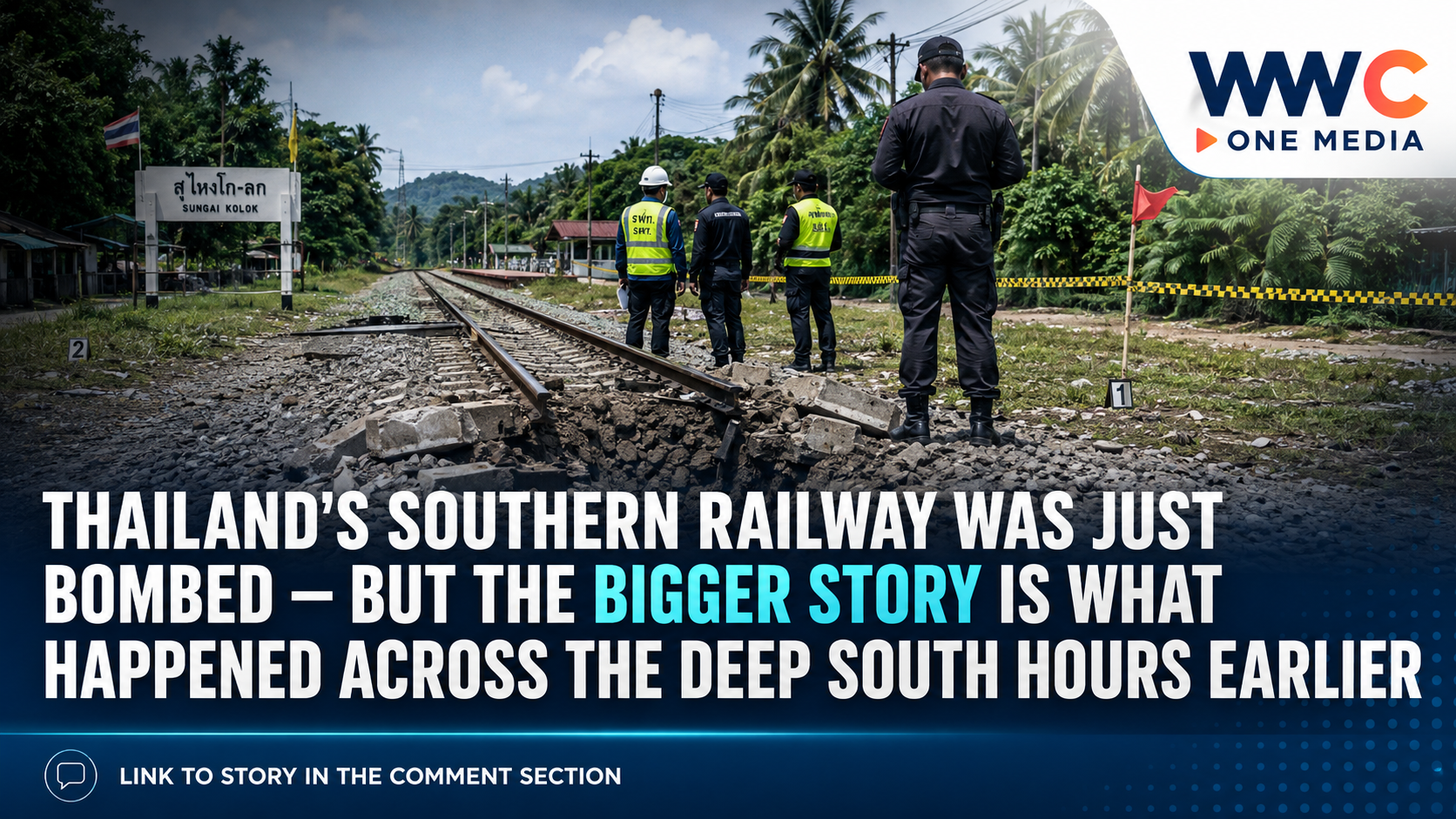
NARATHIWAT, Thailand — A bomb blast has forced Thailand’s railway authority to shut a section of the southern rail network in Narathiwat, disrupting passenger services just hours after a wave of coordinated violence swept across the country’s restive Deep South.
The State Railway of Thailand temporarily closed the track between Maruebo and Tanyong Mat stations in Ra-ngae district on Sunday, August 23, after railway and security personnel discovered blast damage along the line. A drone inspection found that two concrete railway sleepers had been damaged, according to The Nation. No injuries or deaths were reported from the railway explosion.
The incident came after a night of bombings, arson attacks and other acts of disruption across Narathiwat, Pattani and Yala, adding fresh pressure to a region already experiencing one of its most serious spikes in violence this year.
Railway Services Disrupted as Security Teams Search for More Explosives
The damaged section lies at approximately kilometre 1090/6-7 between Maruebo and Tanyong Mat.
Explosive ordnance disposal teams and security personnel were deployed to inspect the railway before State Railway engineers could enter and begin repairs. Thai railway officials said repair crews and equipment were prepared, but work could begin only after security agencies formally declared the area safe.
The State Railway estimated that track repairs could take roughly three hours once engineers were cleared to enter the site, although reopening ultimately depended on the outcome of the security inspection.
The shutdown immediately affected several long-distance and local trains.
Special Express Train No. 37 from Krung Thep Aphiwat Central Terminal to Su-ngai Kolok was ordered to reverse after reaching Maruebo and wait at Yala. Rapid Train No. 172 from Su-ngai Kolok to Bangkok was suspended pending reopening of the line.
Multiple local services connecting Yala, Tanyong Mat, Su-ngai Kolok, Nakhon Si Thammarat, Phatthalung and Surat Thani were also shortened, turned back or temporarily cancelled across portions of the affected route.
Authorities decided not to transfer passengers by road through the affected area because of security concerns.
Railway Bombing Was Only Part of a Much Bigger Night of Violence
The railway explosion did not occur in isolation.
Beginning on Saturday evening, August 22, coordinated attacks were reported at numerous locations across Thailand’s three southern border provinces.
An initial security assessment recorded 34 incidents by around 9:42 p.m., including arson, bomb explosions and gunfire. Later reporting citing authorities put the overnight total at 51 incidents, illustrating how quickly the scale of the unrest expanded as reports continued arriving from individual districts.
The Nation reported that three additional explosions occurred in Pattani and Narathiwat on Sunday morning.
One blast struck near the Sai Nok junction in Yaring district, Pattani. Two further explosions were reported in Su-ngai Padi district, Narathiwat, including one near an electricity pole along Route 4056.
No injuries were reported in those three blasts.
The cluster of attacks raises concern that infrastructure, transportation routes and other public facilities may increasingly be targeted alongside traditional security installations.
Why Thailand’s Deep South Remains a Flashpoint
Narathiwat, Pattani and Yala sit at the heart of Thailand’s decades-old southern insurgency.
The predominantly Malay-Muslim region was historically connected to the former Malay sultanate of Patani and has experienced recurring separatist violence for decades.
The latest phase of the insurgency intensified in 2004, and the conflict has since killed more than 7,800 people, according to Reuters. The Barisan Revolusi Nasional, or BRN, has been the leading insurgent organization during the current phase of the conflict.
Bombings, shootings, roadside attacks and assaults on security posts have periodically disrupted transportation, commerce and daily life across the southern provinces.
Just last month, five security personnel were killed and six civilians wounded in an attack in Narathiwat, highlighting the renewed intensity of the violence.
The Timing Could Complicate Thailand’s New Peace Push
The latest attacks are particularly significant because Bangkok has recently signalled that it wants to revive negotiations aimed at ending one of Southeast Asia’s longest-running insurgencies.
Thailand’s chief southern peace negotiator Thanut Suvarnananda told Reuters this month that the government wanted to move beyond negotiations based simply on exchanging concessions for reductions in violence.
Instead, Bangkok is considering discussions covering deeper political issues, including forms of local governance and decentralisation. Amnesty, pardons or reduced sentences for certain insurgency suspects have also been discussed.
Thai negotiators and BRN representatives had been moving toward a possible preliminary framework as early as September, Reuters reported.
But renewed violence could once again derail that momentum.
Peace negotiations facilitated by Malaysia have repeatedly stalled since talks formally began in 2013 because of political upheaval, disagreements between the parties and continued attacks on the ground.
A Railway Attack Carries Symbolic and Economic Weight
Targeting railway infrastructure has consequences beyond temporarily stopping trains.
Southern Thailand’s rail system remains an important transportation link connecting communities across Yala and Narathiwat with Hat Yai, Bangkok and the Malaysian border.
For residents who rely on public transportation, even relatively limited damage can force cancellations, isolate communities and disrupt work, school and commerce.
That makes transportation infrastructure a particularly sensitive target: the physical damage may be repaired within hours, but the psychological impact—and the disruption to public confidence—can last considerably longer.
The August 23 railway blast therefore represents more than a damaged pair of concrete sleepers.
It comes at a moment when Thailand is simultaneously attempting to contain renewed violence and convince insurgent factions that negotiations can still produce meaningful political outcomes.
Whether the latest attacks become another temporary spike—or the beginning of a wider escalation—could determine the future of both security operations and Thailand’s fragile southern peace process.