
Tommy Koh Ends 55 Years at Singapore’s MFA — But His Biggest Warning Is About What Small Countries Must Never Do

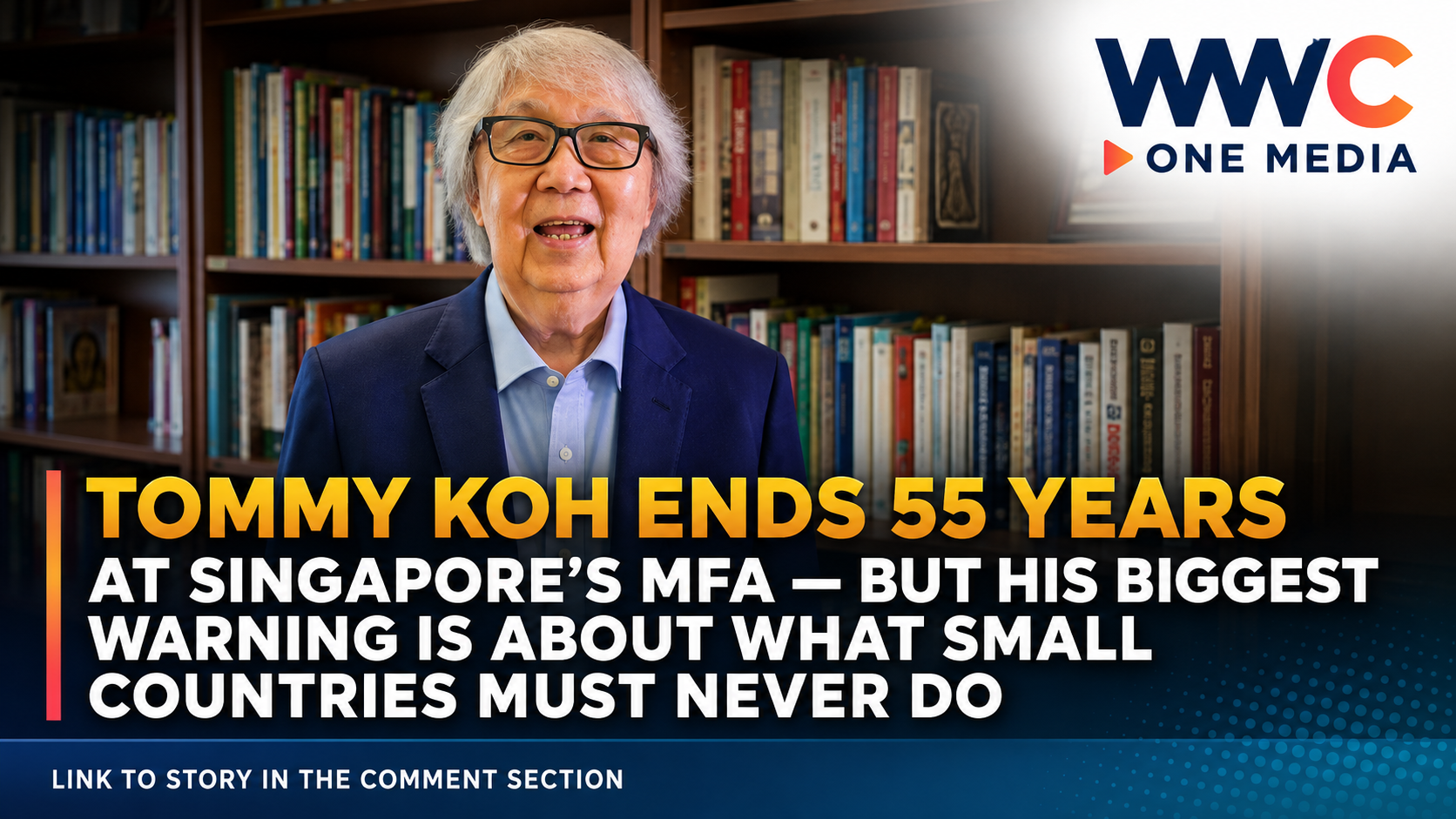
SINGAPORE — After more than half a century representing Singapore on some of the world’s biggest diplomatic stages, Professor Tommy Koh has stepped away from the Ministry of Foreign Affairs with a message that reaches far beyond his own retirement.
For the 88-year-old veteran diplomat, Singapore’s survival has never depended simply on economic success, military strength or relationships with powerful countries.
It depends on something more difficult to maintain: relevance.
Reflecting on 55 years of diplomacy in an interview with CNA published on September 4, Koh summed up one of the principles he says has shaped Singapore’s foreign policy since its earliest years.
Singapore’s “perpetual karma is to be relevant”, he said — a striking description of the challenge facing a small state operating in an increasingly fractured international system.
And the timing of that warning is significant.
Koh retired from Singapore’s Ministry of Foreign Affairs at the end of August, just months before the country enters a crucial diplomatic year in which it will prepare to assume the ASEAN chairmanship in 2027.
FROM A COUNTRY WITHOUT A PROFESSIONAL FOREIGN SERVICE TO A GLOBAL DIPLOMATIC PLAYER
Koh’s career stretches back almost to the beginning of independent Singapore itself.
Singapore became independent in 1965, but according to Koh, the country initially did not even have a formal professional foreign service.
When he was sent to the United Nations in 1968, he was a 30-year-old law academic thrust into international diplomacy at a time when the young republic was still establishing its position in the world.
Koh told CNA that after returning from the UN in 1971, Singapore still lacked a dedicated foreign service. He recalled pushing founding prime minister Lee Kuan Yew to establish one, arguing that the country needed institutional memory and specialist diplomatic expertise.
Lee initially questioned whether ambitious young Singaporeans would want careers in such a small service, Koh recalled.
But the case was eventually accepted.
The episode illustrates how dramatically Singapore’s diplomatic machinery has evolved since independence — and how closely Koh’s career was intertwined with that transformation.
FIVE DECADES AT THE CENTRE OF SINGAPORE DIPLOMACY
Koh eventually became one of the most recognisable figures in Singapore diplomacy.
NUS records show that he served as Singapore’s Permanent Representative to the United Nations from 1968 to 1971 and again from 1974 to 1984.
He then became Singapore’s Ambassador to the United States, serving from 1984 until 1990.
But his influence extended far beyond bilateral diplomacy.
Koh played a major role in negotiations leading to the United Nations Convention on the Law of the Sea, or UNCLOS, and served as president of the Third UN Conference on the Law of the Sea during its decisive final period.
The convention became one of the foundations of modern international maritime law, establishing rules covering territorial waters, navigation rights, exclusive economic zones and the use of ocean resources.
He later chaired work connected with the 1992 UN Earth Summit and served as Singapore’s chief negotiator for the US-Singapore Free Trade Agreement, negotiated between 2000 and 2003.
His career also included Singapore’s legal disputes with Malaysia and contributions to ASEAN institution-building.
Yet Koh’s broader argument is that Singapore’s diplomacy has never been simply about accumulating prestigious appointments.
It has been about ensuring that other countries continue to see Singapore as useful.
THE LESSON: SMALL DOES NOT MEAN POWERLESS
One of Koh’s strongest messages from his farewell reflections concerns how small states respond to great-power competition.
Singapore, he argued, cannot behave as though its size means it has no choices.
Koh said the country should protect its sovereignty, expand its economic and political space, maintain as many friendships as possible and avoid unnecessarily creating enemies.
Most importantly, Singapore should not assume that it must automatically submit to larger powers simply because they are stronger.
That philosophy has become increasingly relevant as competition among major powers puts smaller countries under pressure to take sides.
Koh’s preferred alternative is active diplomacy: building coalitions, supporting international institutions and creating enough diplomatic value that Singapore remains a country others want at the table.
WHY ASEAN 2027 MAKES HIS MESSAGE MORE IMPORTANT
Singapore’s next major regional test is already approaching.
The country will assume the ASEAN chairmanship in 2027, eight years after it last held the rotating role in 2018.
Singapore’s Foreign Ministry has confirmed preparations for a series of high-level meetings during the chairmanship, including ASEAN summits involving heads of state and government.
Foreign Minister Vivian Balakrishnan has also indicated that ASEAN centrality and resilience will be important themes as Singapore prepares to lead the bloc.
The challenge is substantial.
ASEAN must navigate competition among major powers, economic fragmentation, supply-chain vulnerabilities, conflict in Myanmar, security tensions and pressure on the rules-based international system.
Koh believes ASEAN possesses one advantage that is easy to underestimate: trust.
Major powers may distrust one another, but ASEAN can still bring competing countries into the same diplomatic room because the organisation is broadly viewed as an acceptable convenor.
That ability to convene, Koh argued, gives Southeast Asian states influence that exceeds their individual economic or military weight.
He also described ASEAN as collectively the world’s fifth-largest economy and said the bloc could eventually become the fourth-largest.
For Koh, however, economic weight alone is not ASEAN’s real strategic asset.
Its value lies in remaining a platform through which countries with sharply different interests can continue talking.
INTERNATIONAL LAW IN A WORLD INCREASINGLY RULED BY POWER
Koh’s retirement also comes at a difficult moment for the international system he has spent much of his career defending.
Wars, geopolitical rivalry and challenges to established international rules have raised questions about whether international law still offers meaningful protection when major powers choose to ignore it.
Koh does not dismiss that danger.
His own diplomatic career began during the Cold War, when he witnessed powerful states violate international norms despite the existence of treaties and international institutions.
But his conclusion is not that international law has failed.
It is that smaller countries have even more reason to defend it.
A world governed primarily by power would place states such as Singapore at an obvious disadvantage. A system governed as much as possible through agreed rules, courts and international institutions gives smaller countries additional protection and diplomatic space.
That principle has remained remarkably consistent throughout Koh’s career.
A MAJOR ASIAN HONOUR ARRIVES AS HIS MFA CAREER ENDS
His retirement has also coincided with another major milestone.
On August 31, Koh was named one of the recipients of the 2026 Ramon Magsaysay Award, one of Asia’s most prominent honours for public service and leadership.
The Ramon Magsaysay Award Foundation cited his decades of work advancing international cooperation, dialogue and peaceful dispute resolution, highlighting his contribution to UNCLOS as well as his influence in academia and public life.
Associated Press reported that Koh is being honoured alongside Myanmar human-rights activist Bo Kyi and Bangladeshi humanitarian Runa Khan.
The recipients are scheduled to receive their awards in Manila on November 15, 2026.
Koh is only the fourth Singaporean to receive the Ramon Magsaysay Award, according to CNA.
Shortly before leaving MFA, he was also presented with the ministry’s inaugural Lifetime Distinguished Service Award.
Koh announced in August that although he was leaving MFA, he was not disappearing from public life. From September, he would be based at the National University of Singapore’s Centre for International Law.
THE BIGGER STORY IS WHAT COMES AFTER TOMMY KOH
It would be easy to frame Koh’s retirement simply as the end of an extraordinary diplomatic career.
But that misses the more consequential question.
The international environment confronting Singapore today may be more unpredictable than at almost any point since the end of the Cold War.
Global trade is under pressure. Strategic rivalry is intensifying. International rules are being challenged. ASEAN is attempting to maintain cohesion while dealing with conflicts and competing major-power interests.
And in 2027, Singapore will again be expected to help steer Southeast Asia through that uncertainty.
Koh’s 55-year career offers one consistent lesson for the generation taking over:
A small country does not become influential by pretending to be powerful.
It becomes influential by being credible, useful, connected and difficult to ignore.
That may explain why Koh’s most important message as he leaves the foreign ministry is not really about his past at all.
It is about whether Singapore can continue making itself relevant in the world that comes next.