
Tourists Are Still Flocking to Thailand — But the Numbers Reveal a Problem the Country Can’t Ignore

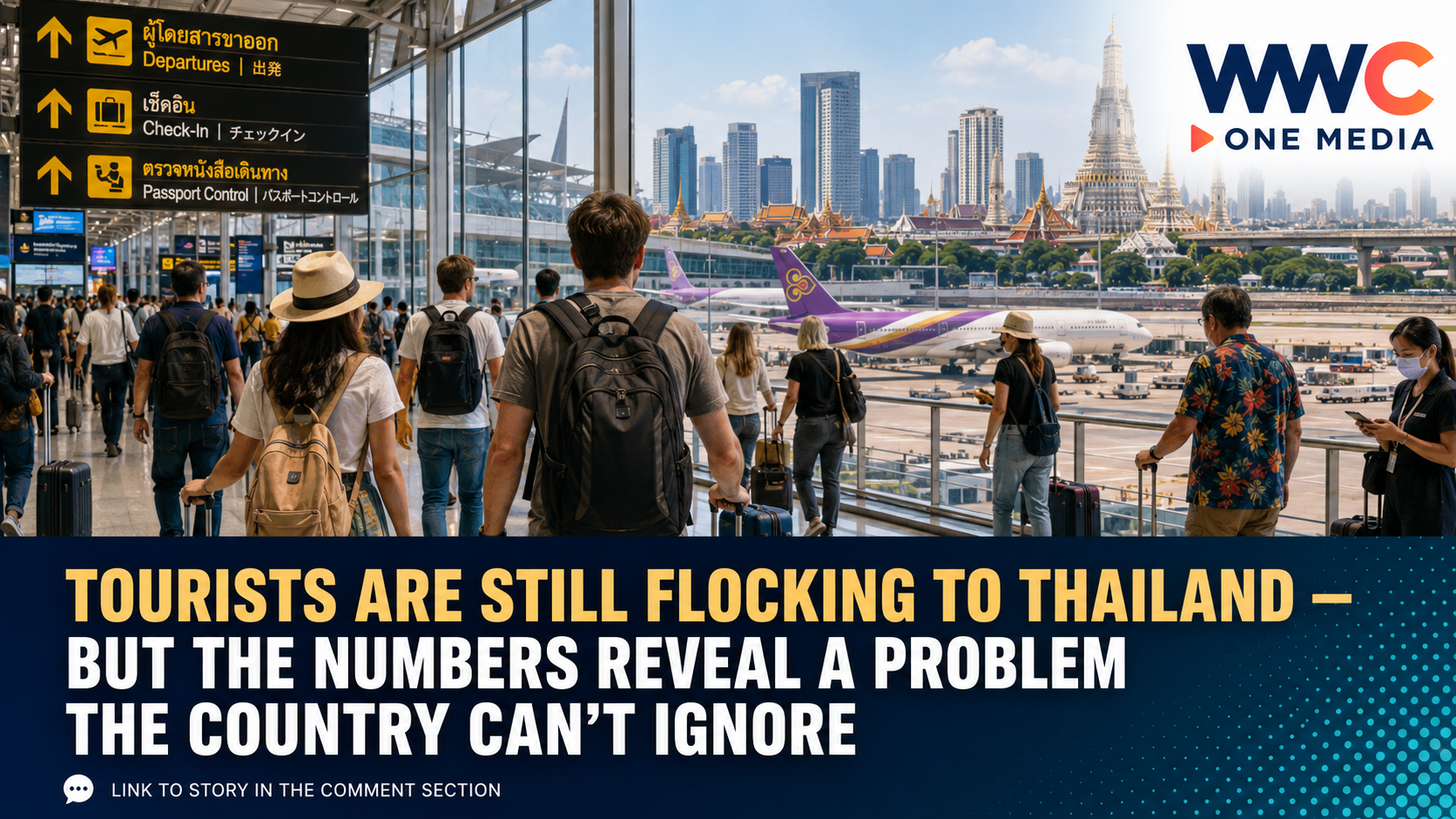
BANGKOK — Thailand may still be welcoming millions of international travelers, but beneath the crowded beaches, packed airports and busy tourist districts, new figures are flashing a warning sign for one of Southeast Asia’s most tourism-dependent economies.
Foreign tourist arrivals to Thailand reached 19.76 million between January 1 and August 15, 2026, but that was 2.91% lower than during the same period a year earlier, according to preliminary data from Thailand’s Ministry of Tourism and Sports.
Those visitors generated an estimated 957.62 billion baht in spending, highlighting the enormous economic value tourism continues to bring even as overall visitor growth struggles to regain momentum.
The slowdown is becoming increasingly important for Thailand because tourism is not simply a leisure industry. Hotels, restaurants, airlines, transport operators, retail businesses and millions of workers depend directly or indirectly on visitor spending.
And several pressures are now converging at the same time.
Middle East Conflict Hits Long-Haul Travel
Thai PBS reported that the prolonged conflict in the Middle East has become one of the biggest external threats facing Thailand’s tourism industry, disrupting airline operations, increasing travel costs and weakening demand from some important long-haul markets.
Research from Krungthai COMPASS, the research arm of Krung Thai Bank, has warned that aviation disruptions linked to Middle East tensions can have an outsized impact on Thailand.
The problem extends beyond tourists coming directly from Middle Eastern countries.
Many travelers from Europe and other long-haul markets connect through major aviation hubs in the Gulf. Airspace closures, rerouted flights, higher jet-fuel costs and longer journeys can therefore make trips to Thailand more expensive and less predictable.
Krungthai COMPASS previously found that Middle Eastern arrivals dropped sharply after the conflict intensified, while European demand also came under pressure as higher aviation costs spread through international travel markets.
That matters because long-haul travelers are among Thailand’s most valuable visitors.
Krungthai research estimates that tourists from markets including the Middle East, Europe, Russia, the Americas and Oceania typically spend substantially more per trip than the average international visitor.
In other words, losing a high-spending long-haul visitor can hurt tourism revenue more than the headline arrival numbers alone suggest.
Nearly 20 Million Tourists — But Growth Is Still Negative
Thailand nevertheless remains one of the world’s most visited destinations.
By August 15, the country had received 19,759,655 international visitors, according to figures reported by The Nation.
The five biggest source markets were:
- China: 3.33 million visitors
- Malaysia: 2.50 million
- India: 1.46 million
- Russia: 1.14 million
- South Korea: about 729,000
China therefore remains Thailand’s largest tourism market, while India has become an increasingly important pillar of the country’s visitor economy.
But Thailand is facing tougher competition for Asian travelers from destinations including Vietnam, Japan and other regional markets.
Krungsri Research has warned that Thailand’s tourism recovery is being restrained by factors including global economic uncertainty, concerns over travel safety, perceptions that Thailand offers less value for money than before and stronger competition from other Asian destinations.
Weekly Arrivals Also Lost Momentum
The latest weekly figures offer another sign that the recovery remains uneven.
Thailand welcomed 612,643 foreign visitors during August 9–15, down 3.79% from the previous week.
That represented an average of roughly 87,520 international arrivals per day.
Chinese arrivals for the week fell about 4.02%, while Malaysian arrivals decreased roughly 5.05% from the previous week.
There were some bright spots.
Indian arrivals increased around 4.67%, Japanese visitors jumped 13.71%, and arrivals from South Korea rose approximately 5.78% week-on-week. Japan benefited in part from travel surrounding the Mountain Day and Obon holiday period.
The figures show just how quickly Thailand’s tourism performance can change depending on school holidays, airline capacity, regional celebrations and economic conditions in major source markets.
Hotels Are Feeling the Pressure
The slowdown is also beginning to show up in Thailand’s hotel industry.
A survey cited by The Nation found that many Thai hotel operators expected third-quarter 2026 revenue to decline from a year earlier, with smaller hotels and properties in southern Thailand facing particularly intense pressure.
Operators are dealing not only with softer international demand but also fierce price competition.
Bangkok provides an example of the changing market.
During the first half of 2026, Bangkok hotel occupancy reportedly increased to 76.2%, yet average room rates dropped 2.1% to 4,013 baht, causing revenue per available room to slip despite stronger occupancy.
More than 17,000 additional hotel rooms are reportedly scheduled to enter the Bangkok market over the following two years, potentially increasing competition further.
That creates an unusual challenge: hotels may be filling rooms while still struggling to raise prices and profitability.
Tourism Is Giving Thailand's Economy Less Support
The weakness matters far beyond the tourism sector.
A Reuters poll ahead of Thailand’s second-quarter economic data noted that international tourist arrivals had fallen year-on-year and that tourism provided relatively little support to economic growth during the period.
Thailand has historically relied heavily on tourism receipts to generate employment, foreign currency earnings and business activity across sectors ranging from aviation and hospitality to food services and retail.
When international demand weakens, the effects can therefore spread through the wider economy.
Fewer Tourists May Not Automatically Mean Disaster
There is, however, another side to the numbers.
Thailand has increasingly been trying to shift its tourism strategy away from simply chasing record visitor volumes toward attracting travelers who stay longer and spend more.
The strategy is often described as “value over volume.”
That shift may already be visible in some data.
Despite weaker visitor numbers, research has shown that spending per international traveler has improved in some periods, helping cushion the economic impact of lower arrivals.
Second-quarter indicators also suggest that Thailand generated stronger tourism receipts even while receiving fewer foreign visitors, reinforcing the argument that visitor quality and spending are becoming just as important as sheer numbers.
The challenge is ensuring that higher spending per traveler can genuinely compensate for weaker visitor volumes.
Can Thailand Recover During the High Season?
The next major test will come as Thailand approaches the traditional year-end tourism high season.
European winter travelers, Chinese holidaymakers, Indian visitors and tourists from Russia and other long-haul markets could provide a significant boost.
But much will depend on factors Thailand cannot fully control: geopolitical tensions, fuel prices, airline capacity, currency movements and economic conditions in major tourism markets.
Forecasts also differ considerably.
Some tourism-industry projections remain relatively optimistic, while others have been revised downward as geopolitical risks increased.
Krungsri Research, for example, projected 32.5 million international arrivals for 2026 in a July industry assessment, citing reduced flight capacity associated with the Middle East conflict as a major risk.
Other research houses have published different estimates, underscoring how uncertain Thailand’s tourism outlook has become.
For Thailand, the question is therefore no longer simply whether tourists will return.
It is whether the country can continue attracting high-value travelers, keep air connectivity competitive, protect its reputation for safety and value, and defend its position as rival Asian destinations fight for the same visitors.
Nearly 20 million international travelers have already arrived this year.
But with arrivals still running below last year’s level, the final months of 2026 may determine whether Thailand’s tourism slowdown proves temporary — or becomes a much bigger economic problem.