
US and China Military Chiefs Meet as Taiwan Tensions Rise—Why Their Meeting Matters

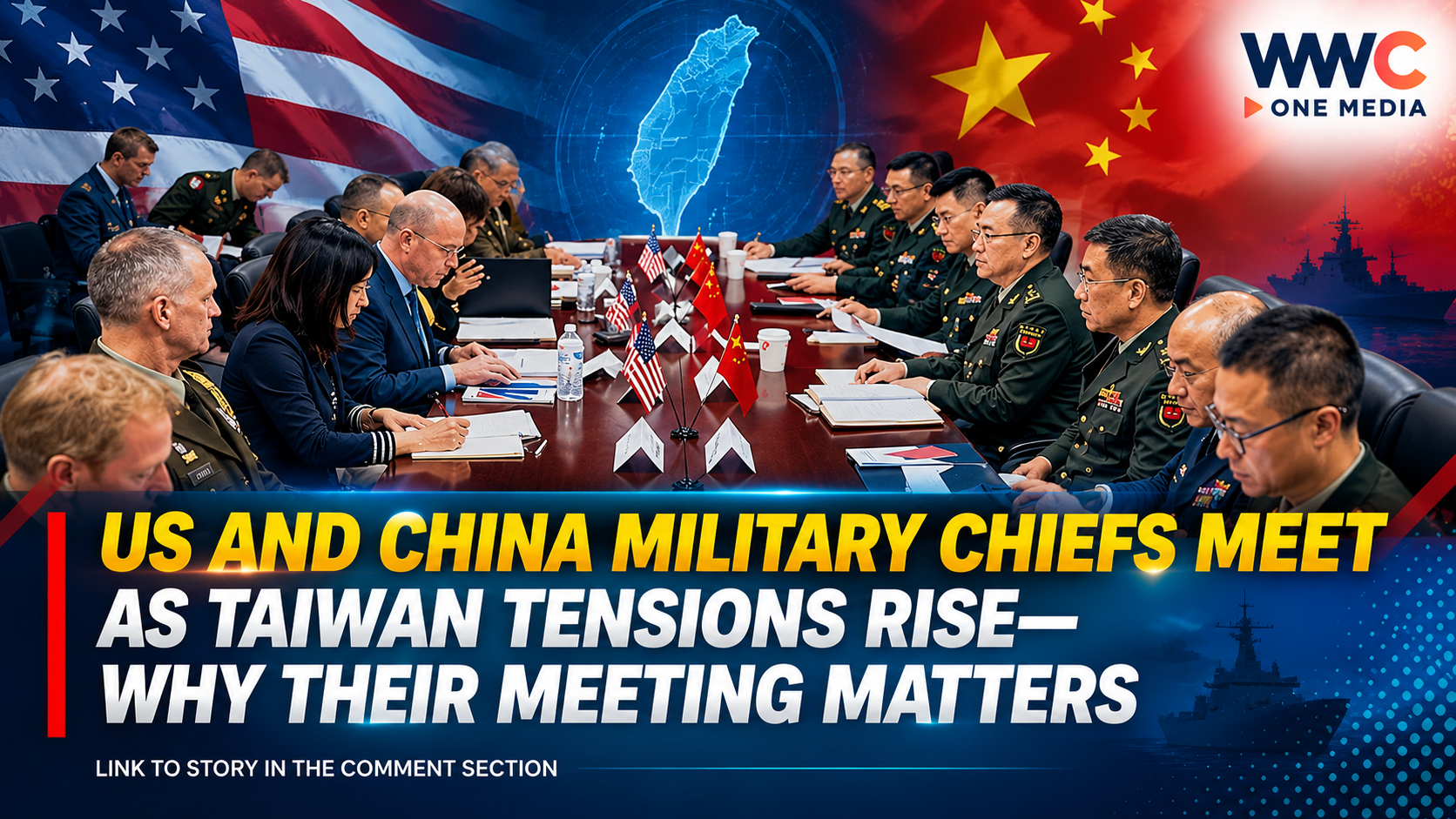
WASHINGTON/BEIJING — A rare high-level military encounter between the United States and China is drawing attention across the Indo-Pacific after the U.S. commander responsible for the region met with a senior Chinese general whose forces oversee military operations involving Taiwan.
U.S. Indo-Pacific Commander Adm. Samuel Paparo met Gen. Yang Zhibin, commander of China's People's Liberation Army (PLA) Eastern Theater Command, on the sidelines of the Indo-Pacific Chiefs of Defense Conference in Victoria, British Columbia, held from Aug. 31 to Sept. 2.
The meeting comes at a particularly sensitive moment for relations between Washington and Beijing, with Taiwan remaining one of the most dangerous potential flashpoints between the two powers.
According to the U.S. Indo-Pacific Command, the two commanders discussed the importance of maintaining open communication between senior U.S. and Chinese military leaders to reduce the possibility of miscalculation and encourage safe, professional conduct between their forces.
That message may sound routine—but against the backdrop of growing military pressure around Taiwan, keeping military communication channels open can be critical.
Why the Chinese commander's identity matters
Yang's position makes the encounter particularly significant.
The PLA Eastern Theater Command is responsible for military operations involving Taiwan, making its commander one of China's most important military figures when it comes to any potential Taiwan contingency.
The meeting therefore brought together the senior U.S. military commander for the Indo-Pacific and the Chinese commander overseeing the PLA theater most directly associated with Taiwan.
It did not, however, signal that Washington and Beijing had reached an agreement on Taiwan or resolved their broader strategic differences.
Instead, the emphasis was on communication and preventing an incident from spiraling out of control.
The danger of miscalculation
The United States and China increasingly operate military aircraft and naval vessels in the same strategically important areas.
Taiwan is at the center of much of that tension.
China claims Taiwan as part of its territory and has repeatedly conducted military activities around the island. Taiwan rejects Beijing's sovereignty claims and maintains its own democratic government and armed forces.
The United States does not maintain formal diplomatic relations with Taiwan, but Washington has longstanding commitments under U.S. law to help Taiwan maintain the ability to defend itself.
That complicated relationship has made military-to-military communication particularly important.
An encounter between aircraft or naval forces can happen quickly. A misunderstanding during such an encounter could potentially escalate before political leaders have time to intervene.
That is why the U.S. Indo-Pacific Command said senior-level communication is intended to reduce the risk of miscalculation and promote professional conduct.
Taiwan's defense buildup adds another layer
The meeting also comes as Taiwan is accelerating its defense preparations.
On Sept. 3, Taiwan's Cabinet proposed an additional NT$145.7 billion (about US$4.6 billion) in defense spending for 2026, with funding directed toward domestically developed military capabilities.
Reuters reported that the proposed spending includes Strong Bow anti-ballistic missile systems, more than 600 coastal surveillance and reconnaissance drones, over 40,000 coastal attack drones and more than 100 unmanned suicide boats.
The proposal reflects President Lai Ching-te's push to strengthen Taiwan's defenses and reduce vulnerabilities in a potential conflict.
Taiwan's parliament had previously approved about US$25 billion in additional spending for U.S.-sourced weapons, while the government has argued that additional domestic capabilities are needed to avoid gaps in its defense plans.
Pressure around Taiwan continues
The military meeting also follows a series of developments showing how complicated the regional security environment has become.
In August, China's Ministry of Natural Resources conducted a seabed survey in waters east of Taiwan, according to Reuters.
Taiwan's authorities objected to the activity, while China's government described the survey as part of its broader maritime and resource-management activities.
Chinese coast guard patrols have also taken place in the waters around Taiwan, adding another layer to what analysts describe as China's expanding use of military and non-military pressure.
These activities do not necessarily mean that conflict is imminent.
But they contribute to an increasingly crowded and contested security environment in which military forces from different countries operate in close proximity.
Washington and Beijing still disagree sharply
The meeting should therefore be viewed against a much larger strategic rivalry.
Washington and Beijing remain divided over Taiwan, military deployments, trade, technology, the South China Sea and China's growing influence across the Indo-Pacific.
The tension was also visible at the Pacific Islands Forum in early September.
Taiwanese Foreign Minister Lin Chia-lung accused China of aggressive “wolf warrior” diplomacy during the gathering, while Beijing objected to Taiwan's participation and warned of unspecified “consequences.”
The confrontation demonstrated that even as military officials seek communication, the underlying political rivalry remains intense.
A meeting does not mean the rivalry is over
The significance of Paparo and Yang meeting is therefore less about a breakthrough agreement and more about keeping a communication channel open between two militaries that could potentially find themselves facing one another during a crisis.
The U.S. military said it remains committed to regional stability, security cooperation and deterrence while promoting peaceful development and responding to potential contingencies.
China, meanwhile, said its delegation at the Canadian conference held bilateral meetings with representatives from several countries and presented Beijing's position on regional peace and defense cooperation.
Neither side has abandoned its broader strategic position.
And Taiwan remains at the center of the problem.
For now, the message from Washington and Beijing is that military communication matters.
But with China's military pressure around Taiwan continuing, Taiwan expanding its defenses and U.S.-China strategic competition intensifying, the bigger question is whether those communication channels will be strong enough if a real crisis suddenly puts them to the test.