
Wonderful Hi-Tech Is Riding the AI Server Boom — But Its 800V and Liquid-Cooling Cables Could Be the Bigger Prize

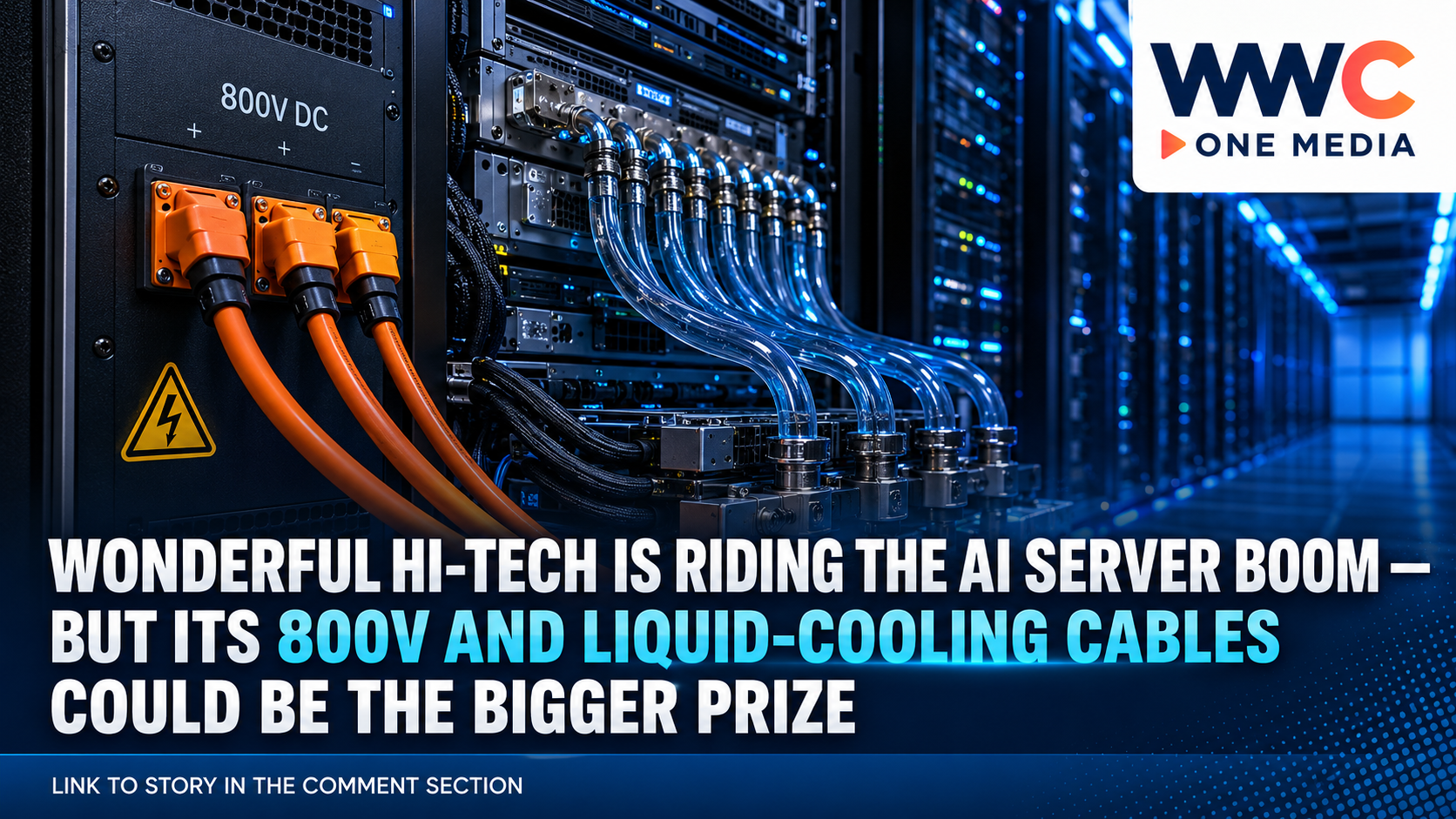
TAIPEI — Taiwan’s Wonderful Hi-Tech Co. is riding the artificial-intelligence infrastructure boom, but its next growth phase could extend far beyond the high-speed cables connecting GPUs inside AI servers.
The New Taipei City-based cable and connector manufacturer says demand is accelerating across AI servers, 800-volt data-center power systems, liquid cooling, low-Earth-orbit satellites, robotics and drones — a widening portfolio that could transform what was once a traditional cable business into a supplier of critical infrastructure for next-generation computing.
Wonderful Hi-Tech expects its 2026 revenue to exceed its NT$10 billion target, after first-half sales jumped 21.4% year-on-year to NT$5.47 billion. Net profit rose 37.1% to NT$249 million, while earnings per share increased to NT$1.35 from NT$1.10 a year earlier.
The numbers matter, but the bigger story is what is driving them.
AI Servers Are Using More Cable, Not Less
As AI computing systems become faster and denser, the amount and value of connectivity inside each server rack is increasing.
Wonderful Hi-Tech currently has roughly 10 million meters of monthly production capacity for bare high-speed cables used in AI servers, with PCIe 6.0 products forming a core part of its business, according to chief executive Steve Chang.
The company argues that the migration toward optical connectivity does not necessarily spell the end of copper. Instead, AI racks are likely to use both technologies: optical connections for certain long-distance, high-bandwidth links and increasingly sophisticated copper connections inside and between racks.
That is significant because every new generation of AI hardware demands faster transmission while squeezing more components into limited physical space.
Wonderful is already developing for the next step. Its own technical materials describe PCIe 6.0 transmission at 64 GT/s and PCIe 7.0-class technology targeting 128 GT/s, with the company working on Twinax cabling and materials designed to maintain signal integrity at those speeds.
Taiwan financial media have also reported that Wonderful is expanding from in-tray and tray-to-tray connections toward rack-to-rack applications, increasing the amount of the AI infrastructure stack it can potentially address.
The Next Bottleneck May Be Power
Moving data quickly is only one part of the AI data-center problem.
The enormous power requirements of next-generation GPU clusters are forcing server and electrical-system designers to reconsider how electricity is distributed inside facilities.
Wonderful said customers in Southeast Asia and India have already made inquiries about high-current cables for 800-volt DC architectures, along with small-diameter flexible cables used around bus-bar systems.
That could become an increasingly important opportunity as data centers move toward higher-voltage architectures designed to deliver huge amounts of power more efficiently.
For Wonderful, that means the AI opportunity is potentially expanding from transmitting bits to transmitting electricity.
Liquid Cooling Creates Another Cable Market
AI servers are also generating so much heat that liquid cooling is becoming an increasingly important part of high-density data-center design.
But putting coolant close to expensive GPUs, motherboards and printed circuit boards creates another problem: leaks.
Wonderful has developed water-leak detection cables that can be wrapped around coolant pipes. The cables are designed to detect small leaks and trigger warnings before liquid reaches sensitive computing hardware.
The company says customer certification of its high-speed AI cables, power products and leak-detection solutions is progressing, with mass shipments of AI-server-related products expected to begin by the end of 2026.
If those certifications convert into large orders, Wonderful could gain exposure to three separate areas of AI infrastructure at once: data transmission, power delivery and cooling protection.
Satellites Are Becoming a Second Growth Engine
Wonderful is also moving aggressively into low-Earth-orbit satellite infrastructure.
The company supplies AC power cords, networking cables and related products used in ground equipment serving LEO satellite systems. Management says shipments to US-based satellite customers have been expanding, while additional satellite-related cable assemblies remain under development.
DIGITIMES reported that strong demand from a major US LEO satellite customer helped drive Wonderful's second-quarter performance and that the company is expanding manufacturing capacity in Thailand and Vietnam as it pursues both satellite and “physical AI” opportunities.
There is, however, an important discrepancy in local reporting over just how large the satellite business will become this year.
Taipei Times and Liberty Times reported that satellite cables are expected to account for roughly 7% of 2026 revenue, around double last year's contribution, with longer-term ambitions to push the share beyond 10%. Economic Daily separately reported that the company discussed a figure as high as 15% during its September investor briefing. Because the reports use different figures, the more conservative 7% estimate should be treated as the clearer near-term benchmark unless Wonderful provides further clarification.
Even at the lower figure, satellite products would represent a meaningful new revenue stream for a company historically associated with conventional networking and electrical cables.
Robots and Drones Could Be the Next Frontier
Wonderful is also looking beyond stationary data centers.
Management says its high-end copper technology is being extended into what the technology industry increasingly calls physical AI — machines such as robots and drones that combine artificial intelligence with sensors, motors and real-world movement.
Those systems require multiple types of connectivity for cameras, networking, actuators and control systems, creating another potential market for lightweight, flexible and high-speed cabling.
The expansion illustrates an important change in the AI supply chain.
Much of the attention remains focused on companies producing GPUs, memory and semiconductor manufacturing equipment. But increasingly powerful AI systems also require enormous supporting ecosystems involving electricity, cooling, networking, connectors and specialized materials.
Wonderful is trying to position itself inside that less-visible layer.
Thailand Expansion Signals Confidence
The company is putting money behind that strategy.
Wonderful has budgeted roughly NT$400 million in capital expenditure for 2026, with about NT$250 million earmarked for a third phase of high-speed cable expansion in Thailand.
The expanded Thailand operation is expected to begin production in 2027. Wonderful has also increased capacity for electron-beam irradiated cables at its Vietnam operation, broadening its Southeast Asian manufacturing footprint.
The geographic diversification is important for another reason: global technology customers increasingly want supply chains that are not concentrated in a single country.
Wonderful currently operates across Taiwan, China, Thailand, Vietnam and the United States and has previously said it wants North America eventually to represent about 40% of revenue, up from 36% in 2025.
Can Wonderful Turn an AI Boom Into a Long-Term Transformation?
Management's ambitions go well beyond one strong year.
Wonderful has previously set a goal of achieving 20% to 25% compound annual revenue growth over the five years through 2030, while increasing the share of higher-margin customized products — particularly those serving AI data centers — from about 18% to 30%.
It is also targeting a longer-term gross margin of roughly 20%.
Those targets are ambitious.
AI infrastructure spending remains powerful, but suppliers still face risks ranging from raw-material costs and customer concentration to rapid technology changes and the possibility that spending by hyperscale data-center operators eventually slows.
Certification is another crucial hurdle. A promising cable design produces little revenue until major server, networking or data-center customers approve it and move into volume production.
That makes the next several quarters especially important.
Wonderful has already demonstrated that AI-related high-speed transmission and satellite demand can move its financial results. What investors will now be watching is whether its newer products — particularly 800V power cables, liquid-cooling leak detection, next-generation high-speed interconnects and physical-AI applications — can successfully move from qualification into sustained mass production.
Because if they do, Wonderful Hi-Tech may no longer be viewed simply as a cable manufacturer benefiting from an AI cycle.
It could become one of the companies supplying the wiring, power and protection systems that make the AI infrastructure boom possible in the first place.
WWC ONE MEDIA J.M.D