
Beer Was Declared as ‘Food’ and ‘Machinery’ in Singapore Tax Scheme — Then Customs Opened the Warehouse

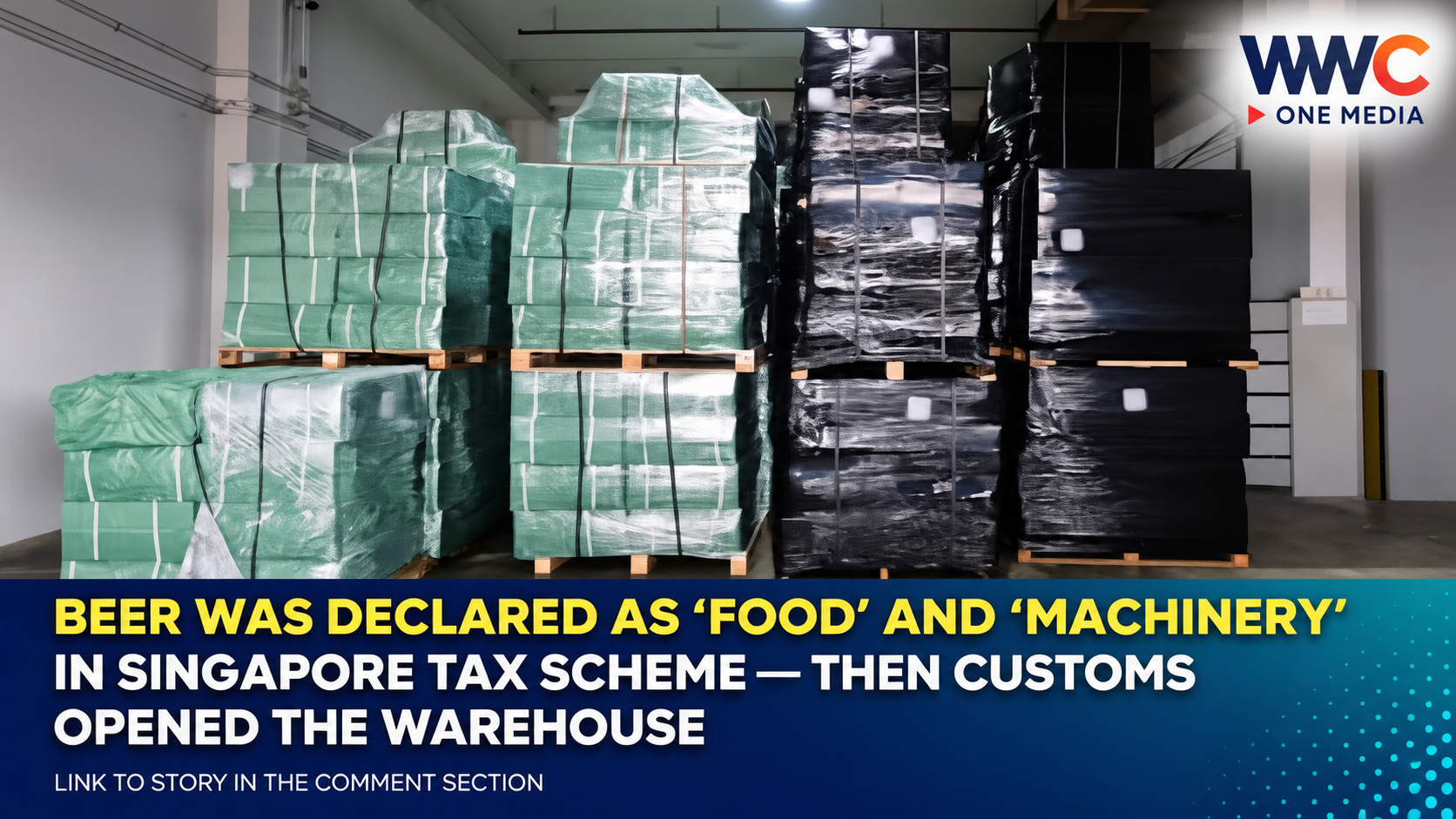
SINGAPORE — Thousands of bottles of beer entered Singapore on paperwork that allegedly made them look like something entirely different.
Food.
Industrial machinery.
Anything, investigators said, except the dutiable alcohol actually sitting inside the shipments.
The scheme eventually led Singapore Customs to more than 35,000 bottles of duty-unpaid beer, a Singapore company used to store and distribute them, two men prosecuted in court—and a S$560,000 fine for the man authorities described as the mastermind.
On September 4, 47-year-old Chinese national Han Xiaoyang pleaded guilty in the State Courts to seven charges of fraudulent evasion of duty under Singapore's Customs Act.
Those seven charges involved approximately S$60,127 in unpaid duty on 28,236 bottles of beer. The court fined Han S$560,000. Because he did not pay the fine, Singapore Customs said he will serve 164 days in imprisonment in default.
But those 28,236 bottles were only part of the story.
Customs Found More Than 35,000 Bottles
The case began to unravel on November 19, 2025.
Singapore Customs officers were conducting an operation at an industrial building along Tagore Lane when they saw two workers transferring liquor into a unit.
Officers inspected the shipment.
Inside were 4,044 bottles of duty-unpaid beer.
The workers identified Tong Baobao, another Chinese national, as the person in charge. Tong later arrived at the building and was arrested.
Follow-up searches produced a much bigger haul.
Customs officers found another 31,016 bottles of duty-unpaid beer stored elsewhere.
That brought the total seizure linked to the operation to 35,060 bottles.
That figure is higher than the 28,236 bottles cited in Han's seven proceeded charges because the court charges do not necessarily represent every bottle seized during an investigation.
The Alleged Trick Was Surprisingly Simple
According to Singapore Customs, Han conceived the scheme and arranged for beer purchased in China to be imported into Singapore.
The objective was straightforward: avoid the duties payable on the alcohol so it could be sold locally at a higher profit margin.
The method depended on false declarations.
Han instructed Tong to coordinate with a freight forwarder in China and have the beer declared as non-dutiable merchandise such as food products or industrial machinery, Customs said.
Han would purchase the beer in China.
The goods would be passed to the freight forwarder.
Documents would describe the shipments as something other than beer.
They would then be exported to Singapore and received by Wan Changya International Pte Ltd, or WCI, a Singapore-incorporated company used for the local operation.
Once the shipments arrived, Tong arranged for them to be stored in WCI's warehouse or other storage units before they were delivered to customers in Singapore, according to investigators.
In other words, authorities say the scheme did not merely involve someone carrying excess alcohol through an airport without declaring it.
It was a commercial supply chain.
Beer was purchased overseas, falsely described on import documentation, brought into Singapore, warehoused and distributed to customers.
The Accomplice Was Sentenced Months Earlier
Tong, 29, had already been sentenced before Han appeared in court.
Singapore Customs said Tong worked as WCI's general manager and acted on Han's instructions.
On May 4, 2026, Tong pleaded guilty to three charges of fraudulent duty evasion involving approximately S$39,517 in unpaid duty.
He was fined S$322,000.
Seven additional charges—two involving duty evasion and five involving fraudulent GST evasion—were taken into consideration during his sentencing.
Tong did not pay his fine and served 80 days' imprisonment in default, according to Customs.
That brought the fines imposed on the two principal figures in the case to S$882,000 combined.
Han Faced More Than the Seven Charges He Admitted
Han's S$560,000 sentence also involved more alleged offending than the headline figure might initially suggest.
While he pleaded guilty to seven fraudulent-duty-evasion charges, the court considered 15 additional charges when determining his sentence.
Those consisted of:
- four further charges of fraudulent evasion of duty; and
- 11 charges of fraudulent GST evasion.
That distinction matters because some coverage describes the case broadly as a GST-evasion operation.
Singapore Customs itself says the overall scheme was intended to evade both duty and Goods and Services Tax, but the seven charges to which Han formally pleaded guilty were specifically duty-evasion charges.
Singapore's current GST rate is 9 percent, and for imported dutiable goods GST is generally calculated on the customs value plus the duties payable.
Why Beer Attracts More Than Ordinary GST
Beer is not treated like an ordinary imported consumer product under Singapore's tax system.
Singapore Customs lists intoxicating liquor as one of the country's categories of dutiable goods. Duties on alcoholic beverages can be calculated according to the quantity of alcohol and alcoholic strength.
For example, Customs' published calculation for stout uses both customs and excise duty rates applied per litre of alcohol.
That means the amount payable on legitimate commercial beer imports can be considerably more complicated than simply applying Singapore's 9 percent GST to the purchase price.
And that helps explain the alleged financial incentive.
If beer can be disguised on shipping documents as merchandise that is not subject to liquor duties, the importer can potentially eliminate a significant part of the tax cost and increase the margin when the alcohol is resold.
Customs said increasing sales profits by avoiding beer duties was specifically the purpose of Han's scheme.
The Penalty Can Reach 20 Times the Tax Evaded
Singapore's penalties are deliberately severe.
Singapore Customs says anyone convicted of buying, selling, transporting, delivering, storing, possessing or otherwise dealing in duty-unpaid liquor can face a fine of up to 20 times the amount of duty and GST evaded.
Imprisonment of up to 12 months may also apply.
That penalty structure helps explain how an underlying duty-evasion figure of about S$60,127 could ultimately produce a six-figure court fine.
It would be misleading, however, to simply divide the S$560,000 fine by S$60,127 and treat that as the precise statutory multiplier applied to the case, because the court also considered another 15 charges when sentencing Han.
Singapore Has Been Intensifying Its Tax-Evasion Enforcement
The case also fits into a broader customs-enforcement picture.
During the first ten months of 2025, Singapore authorities caught 23,742 travellers for failing to declare dutiable or taxable goods at air, land and sea checkpoints.
More than S$7.1 million in penalties was imposed—more than twice the S$3.47 million recorded during the comparable period in 2024.
Those checkpoint cases are different from Han's commercial beer operation, but they demonstrate the authorities' broader focus on protecting customs and GST revenue.
Singapore Customs said at the time that tax revenue belongs to Singapore and that evasion can also disadvantage legitimate businesses that pay the taxes they owe.
Alcohol has repeatedly appeared in major enforcement cases.
In an earlier case, the mastermind of what Customs described as Singapore's largest duty-unpaid alcohol syndicate was fined around S$28 million after liquor supposedly intended for export was illegally diverted for local sale.
Another man was fined more than S$700,000 in 2024 for involvement in a scheme that diverted duty-suspended liquor meant for use as sea stores into Singapore's domestic market.
The methods differ.
The economic objective is essentially the same: get alcohol into the domestic market without paying the taxes required for legitimate local sales.
One Detail Other Coverage Got Wrong
There is also a small age discrepancy worth correcting.
An AsiaOne headline snippet described Han as 49, although the article body gives his age as 47.
The original Singapore Customs court release unequivocally identifies Han Xiaoyang as 47 years old, which is the figure used here.
For legal reporting, the official court-linked government release should take precedence over a conflicting headline or search snippet.
The Bigger Lesson Was Hidden in the Shipping Documents
At first glance, the case looks like a story about tens of thousands of bottles of beer.
But the larger enforcement issue is documentation.
International trade systems rely heavily on importers, exporters and declaring agents accurately identifying what is inside shipments.
Change the product description, value or tariff classification, and the amount collected by the state can change dramatically.
In this case, Customs says the operation attempted to exploit that system by turning beer into “food” or “industrial machinery” on paper.
The boxes themselves did not change.
The labels did.
And once Singapore Customs traced those labels back through the supply chain, the alleged savings disappeared.
Han's seven proceeded charges involved about S$60,000 in avoided beer duty. The resulting fine was S$560,000—and the warehouse search exposed more than 35,000 bottles.
WWC ONE MEDIA M.J.E