
Nearly 800 Indonesians Fall Ill in Fresh Free-Meal Poisoning Outbreaks as Pressure Mounts on Prabowo’s Flagship Program

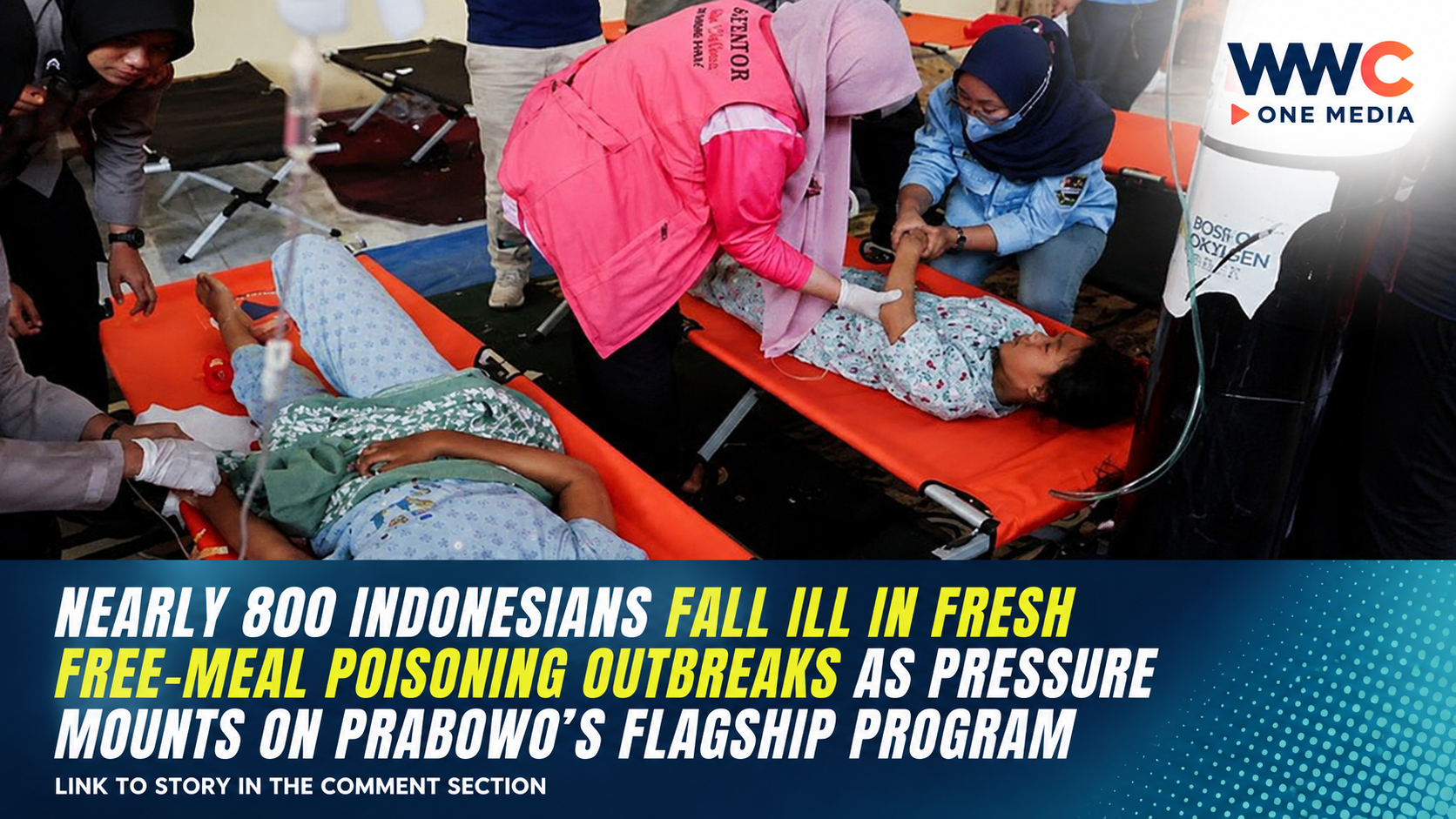
JAKARTA — Indonesia’s ambitious free-meal programme is facing renewed scrutiny after nearly 800 people were reported sick in three separate suspected food-poisoning incidents, including more than 500 students in East Java this week.
The latest cases involve 512 students in Sidoarjo, 49 people in Nganjuk and 237 people in Agam, West Sumatra, according to Charles Honoris, a member of Indonesia’s parliamentary commission overseeing health. He cited local health department data in reporting the figures.
The incidents have intensified concerns over food safety in President Prabowo Subianto’s Free Nutritious Meals (MBG) programme, one of the government's flagship policies aimed at tackling malnutrition.
More than 500 students sick in East Java
The largest of the latest outbreaks occurred in Sidoarjo, East Java, where hundreds of students became ill after consuming meals supplied through the government programme.
Indonesia’s National Nutrition Agency (BGN), which oversees MBG, said 512 students received medical treatment. As of Sept. 2, 80 remained hospitalised, while 312 had been discharged and another 120 were still under observation.
Authorities have not yet confirmed what caused the illnesses.
BGN said laboratory testing and an investigation with local health authorities were still underway. The agency has therefore cautioned against drawing conclusions about the exact source of the poisoning before the investigation is complete.
BGN has nevertheless imposed a 30-day suspension on the SPPG kitchen in Talangangin, Kalitengah, Sidoarjo, and ordered the removal of the kitchen's head while the investigation proceeds.
Two other outbreaks add to the concern
The Sidoarjo incident was followed by reports of 49 cases in Nganjuk, East Java, and 237 cases in Agam, West Sumatra, bringing the three reported incidents to 798 people.
The Agam cases involved students and teachers across several schools. Local authorities said health officials and Indonesia’s food and drug regulator were investigating, and there was not yet an official conclusion that the MBG meals caused the illnesses.
That distinction is important: while the cases have been reported in connection with people who consumed MBG meals, investigations into the precise causes are still ongoing.
The latest cases are not happening in isolation
The new outbreaks come after several other food-safety incidents involving Indonesia's free-meal programme.
In August, 707 students and teachers in Semarang were reported sick after consuming MBG meals. The Jakarta Post reported that 13 people were hospitalised and that the responsible meal provider was suspended while an investigation was conducted. An initial investigation pointed to issues involving ingredients and the timing of food preparation.
Another incident in North Sumatra left more than 350 students ill. The National Nutrition Agency said its initial investigation found that hundreds of fish had been left at room temperature for roughly 12 hours instead of being properly refrigerated. The kitchen was suspended and its head dismissed.
These incidents have placed food storage, preparation, transportation and kitchen oversight at the centre of the debate surrounding MBG.
Watchdog reports tens of thousands affected
The scale of the wider problem is even more significant.
The Network for Education Watch, a non-governmental watchdog, reported that approximately 37,600 people had been affected by food-poisoning incidents linked to the programme as of Aug. 8. Reuters and CNA both cited the watchdog's figure.
The Jakarta Post separately reported that the Indonesian Education Monitoring Network had counted 40,759 students, teachers, pregnant women and toddlers who had fallen ill after consuming meals supplied under the programme since its launch. The two figures come from different reporting periods and organisations, so they should not be added together.
Experts and previous investigations have pointed to problems such as improper food storage and delays in delivering cooked meals as recurring food-safety risks.
Government has already shut hundreds of kitchens
The Indonesian government has been responding with tighter inspections and closures.
BGN said in August that 504 MBG kitchens had been permanently closed after being deemed unsuitable on sanitation grounds. It also said roughly 3,000 additional kitchens were undergoing inspection.
The agency has described food safety as a priority and said it wants a zero-tolerance approach to poisoning incidents.
The government has also undergone changes in BGN leadership. President Prabowo replaced the agency's leadership in June as part of an effort to strengthen its management and accelerate the programme.
Why the programme matters to Prabowo
MBG is not a small pilot project. It has become one of the largest government nutrition programmes in Indonesia.
The programme officially began in January 2025, and by March 2026, BGN reported more than 61.2 million beneficiaries, including more than 49 million school students.
President Prabowo said in February that the programme had reached about 60 million beneficiaries, with the government targeting 82 million or more by the end of 2026.
That enormous scale also makes food safety more complicated: meals have to be prepared, stored and transported across thousands of locations every day.
A growing political and public-relations challenge
The latest incidents could further test public confidence in a programme that Prabowo has repeatedly defended as essential to fighting child malnutrition.
A July survey by Saiful Mujani Research and Consulting found that only around one-third of respondents were satisfied with the programme, with reported food-poisoning cases among the reasons for dissatisfaction, according to Reuters and CNA.
Prabowo has argued that the number of poisoning cases should be viewed against the enormous number of meals already distributed. He has also maintained that the programme is producing positive results and should continue, while acknowledging that implementation problems need to be addressed.
For the government, however, the latest 798 reported cases underline a difficult question: Can Indonesia expand one of the world's largest school-meal programmes while maintaining food-safety standards at every kitchen and delivery point?
The answer could determine not only the credibility of MBG, but also public confidence in one of Prabowo's most important national policies.
WWC ONE MEDIA J.M.D