
PH, US Marines Launch MASA 2026 in Ilocos Norte — But the Real Focus Goes Far Beyond Aviation

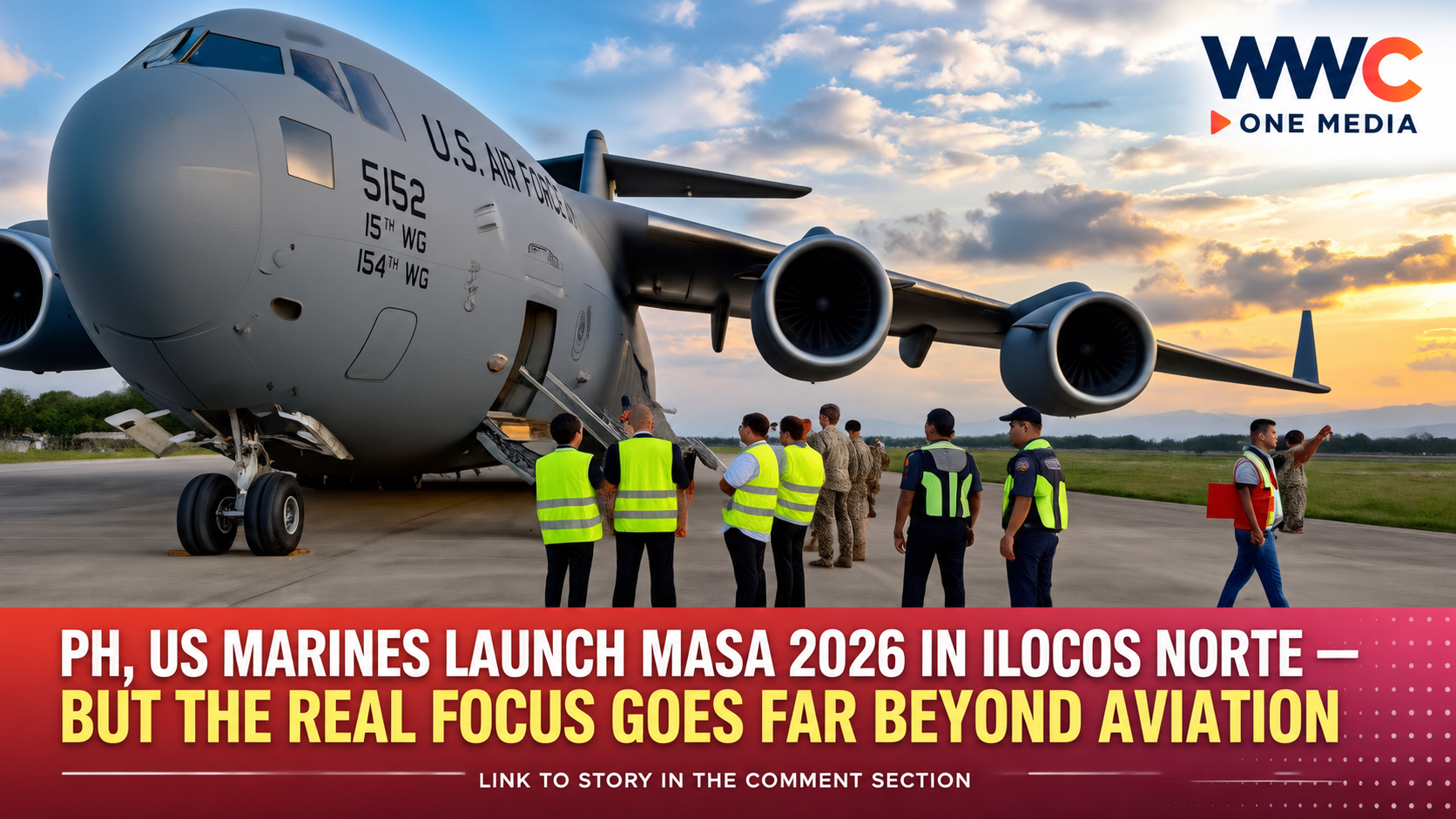
ILOCOS NORTE, Philippines — Philippine and United States Marines have opened the 2026 Marine Aviation Support Activity, or MASA 2026, in Ilocos Norte, adding another major bilateral exercise to a year of increasingly integrated military training between the two longtime treaty allies.
But despite the word “aviation” in its name, MASA has evolved into something considerably broader.
The annual exercise is designed to strengthen the ability of Philippine and American forces to operate together across aviation, maritime, ground and logistics missions—capabilities that have taken on greater importance as Manila shifts its military toward territorial and coastal defense.
The Philippine Navy had announced ahead of the exercise that the Philippine Marine Corps and U.S. forces were preparing for MASA 2026 to strengthen mutual defense, interoperability and maritime and aviation capabilities.
For Washington, MASA 2026 also forms part of a wider effort to integrate the U.S. Marine Corps more closely with the Armed Forces of the Philippines.
Earlier this year, the U.S. Marine Corps said its Marine Rotational Force–Southeast Asia would participate in Balikatan 2026, KAMANDAG 10 and MASA 2026, with each exercise developed alongside Philippine forces to support Manila's defense objectives.
The rotational force is also being aligned with the Philippines' Comprehensive Archipelagic Defense Concept, which places greater emphasis on defending the country's territory, maritime approaches and strategically important islands.
Why Ilocos Norte matters
The choice of Ilocos Norte is significant.
Northern Luzon has emerged repeatedly as a major training area for increasingly complex Philippine-U.S. military operations.
During Balikatan 2026, more than 17,000 personnel from the Philippines, United States and participating partner countries were involved in exercises across the country. Ilocos Norte hosted a counter-landing live-fire exercise at the La Paz Sand Dunes as well as a planned joint maritime-strike event in Paoay.
Then in June, Philippine and U.S. Marines conducted KAMANDAG 10, another major exercise focused on territorial defense, coastal defense and interoperability.
KAMANDAG activities included maritime-strike operations, counter-landing exercises, airfield seizure and defense, island defense, amphibious raids and seaborne maneuver, with training locations stretching from Northern Luzon to Palawan and Tawi-Tawi. Japan and South Korea also participated alongside the Philippines and United States.
MASA therefore comes not as an isolated military event but as another layer in an increasingly continuous training cycle between Manila and Washington.
MASA has become more than an aviation drill
Earlier editions show how much the exercise has expanded.
During MASA 2024, Philippine and American forces trained across air, sea and land domains from Palawan to Batan.
That exercise incorporated subjects ranging from integrated air and missile defense and communications to close-air support, engineering, explosive ordnance disposal and expeditionary aviation operations.
One of MASA 2024's centerpiece events was a littoral live-fire exercise involving Philippine artillery and U.S. Marine Corps F-35B fighters striking simulated maritime targets.
U.S. military accounts said the event tested combined command-and-control procedures in a territorial-defense scenario involving coordinated surface and maritime strikes.
Those previous deployments, however, should not automatically be taken as confirmation that the same aircraft or weapons systems will participate in MASA 2026. Military authorities have yet to publicly detail all of the equipment involved in this year's exercise.
What is clear is the operational direction: Philippine and American forces are increasingly training to communicate, move, supply and fight together across dispersed locations.
A defense partnership getting deeper
The latest exercise also begins amid renewed assurances that U.S.-Philippine defense cooperation remains intact despite shifts in American military deployments elsewhere.
Philippine Defense Secretary Gilberto Teodoro Jr. said on September 7 that there had been no reduction in military cooperation between Washington and Manila, while U.S. officials had reaffirmed that commitments under the 1951 Mutual Defense Treaty remained unchanged.
That follows similar assurances in August, when Philippine military officials said the redeployment of some American assets toward the Middle East was not expected to reduce joint exercises or broader defense cooperation with Manila.
The Mutual Defense Treaty remains the foundation of the alliance, committing both countries to respond to an armed attack against either party in the Pacific area.
The relationship is supplemented by the Visiting Forces Agreement and Enhanced Defense Cooperation Agreement, arrangements that have enabled increasingly sophisticated joint training and greater access for U.S. forces to agreed Philippine military locations. U.S. military material identifies those agreements as part of the foundation supporting exercises such as MASA.
Bigger strategic picture
The tempo of exercises comes as the Philippines continues to modernize its armed forces and strengthen security partnerships amid persistent tensions in the South China Sea.
Manila has expanded defense relationships not only with Washington but also with countries including Japan, Australia, Canada, France, New Zealand and Britain.
Teodoro said this week that concerns about China's actions in the Indo-Pacific were among the factors encouraging countries to deepen security cooperation.
U.S. defense officials have meanwhile emphasized that Washington wants regional allies to develop stronger defensive capabilities rather than depend entirely on American forces.
During an August visit to Manila, senior Pentagon official Elbridge Colby said the United States remained committed to Asia and described its approach as seeking “partners, not protectorates.”
That makes exercises such as MASA increasingly important.
Their value is not measured only by how many aircraft fly or how many troops deploy. The more consequential test is whether Philippine and U.S. forces can communicate, coordinate targeting, move personnel and equipment, sustain dispersed units and respond together quickly during an actual crisis.
For MASA 2026, Ilocos Norte is once again becoming the laboratory where some of those capabilities are put to the test.
And after Balikatan and KAMANDAG pushed Philippine-U.S. training deeper into territorial and coastal-defense scenarios earlier this year, the bigger question surrounding MASA 2026 is no longer whether the alliance is becoming more operational—it is how far that integration will go.
WWC ONE MEDIAM M.J.E