
Philippines Farm Losses Hit ₱4.38 Billion After Habagat, 4 Cyclones — But the Biggest Threat May Not Be Over

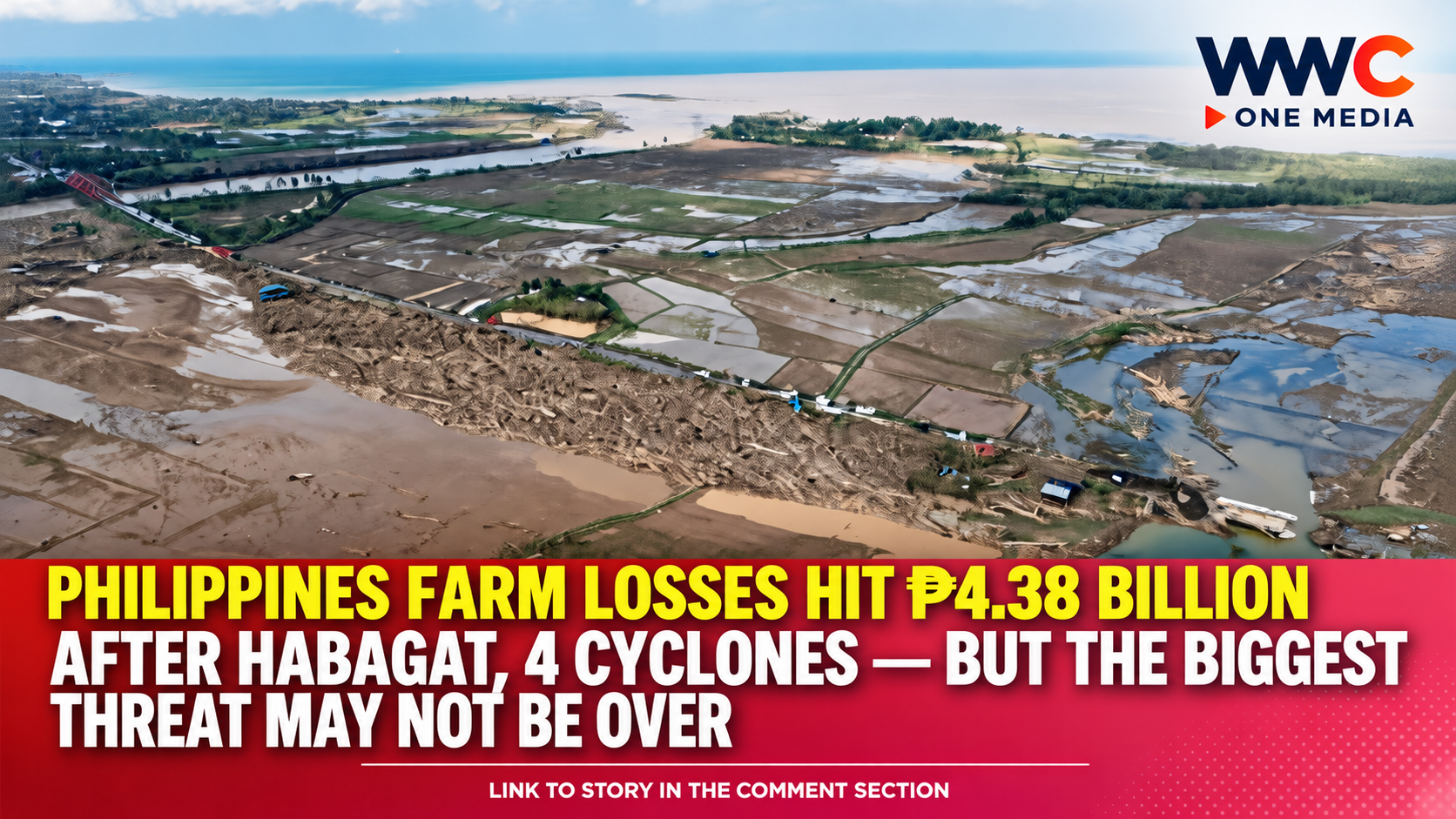
MANILA, Philippines — The cost of weeks of punishing weather on Philippine farms is becoming clearer — and the damage is now well into the billions.
Agricultural damage and production losses caused by the enhanced southwest monsoon, or Habagat, and tropical cyclones Luis, Maymay, Neneng and Pilandok have climbed to ₱4.38 billion, according to the Department of Agriculture’s final assessments from affected regional offices.
The latest tally shows the scale of the disaster has expanded sharply: 99,663 farmers and fisherfolk, 81,511 hectares of agricultural land, and about 102,791 metric tons of agricultural production were affected across eight regions.
The losses were recorded in the Cordillera Administrative Region, Ilocos Region, Cagayan Valley, Central Luzon, CALABARZON, MIMAROPA, Bicol Region and Western Visayas.
And one staple stands out above all the others.
Rice takes the biggest hit
Rice accounted for approximately ₱2.05 billion of the total agricultural damage — almost half of the ₱4.38-billion nationwide tally.
That makes rice by far the biggest single source of losses from the prolonged monsoon rains and successive tropical cyclones.
The next-biggest blow was suffered by high-value crops, with losses reaching approximately ₱1.38 billion.
The affected high-value crops span a wide portion of the food supply chain, including upland and lowland vegetables, spices, legumes, bananas, mangoes, pineapples, papayas, watermelons, strawberries, calamansi, citrus fruits, durian, lanzones, mangosteen, rambutan, root crops and commercial crops.
The wide range of damaged produce matters because the impact of extreme weather does not end when floodwaters recede. Destroyed vegetables and fruit crops can mean lost income for producers, tighter supplies in some markets and temporary price pressure for consumers.
Agriculture officials have already been monitoring commodity movements and retail prices following the storms.
Fisheries losses surge to nearly ₱648 million
The fishing and aquaculture sector was also badly hit.
The DA placed losses to fisheries and aquatic resources at ₱647.79 million, covering products including milkfish, tilapia, mangrove crab, oysters, giant freshwater prawns, catfish, sugpo and fingerlings.
Other losses included:
- Corn: ₱127.60 million
- Cassava: ₱30.94 million
- Livestock and poultry: ₱32.65 million
- Irrigation facilities: ₱72.52 million
- Farm structures: ₱40.64 million
- Agricultural machinery and equipment: ₱6.35 million
Together, rice, high-value crops and fisheries account for the overwhelming majority of the damage.
Damage jumped sharply in only five days
The latest figure also shows how rapidly the government's assessment expanded as field validation continued.
On September 3, the DA was reporting agricultural losses of around ₱3.62 billion, affecting 86,466 farmers and fisherfolk, 74,809 hectares of agricultural areas and 87,745 metric tons of production.
By September 8, the assessment had climbed to ₱4.38 billion, with nearly 100,000 agricultural producers affected.
That means hundreds of millions of pesos in additional losses were confirmed in just several days as regional teams completed their assessments and as the effects of Pilandok were incorporated into the broader tally.
Earlier government figures should therefore not be confused with the newest DA assessment.
For example, the NDRRMC reported on September 7 that its agriculture damage estimate stood at about ₱3.74 billion, alongside roughly ₱7.95 billion in infrastructure damage. Those figures were based on a different reporting cutoff and validation process and preceded the DA's latest ₱4.38-billion final agricultural assessment.
Nearly 100,000 livelihoods behind the numbers
The ₱4.38-billion figure represents more than damaged crops and flooded farmland.
Nearly 100,000 farmers and fisherfolk now face the costly task of rebuilding livelihoods, replacing inputs and recovering lost production.
For small producers, a destroyed rice field, vegetable crop or fishpond can erase months of investment before the farmer has received any income from the harvest.
The DA says ₱609.79 million worth of agricultural inputs — including rice, corn and vegetable seeds — have been lined up for affected producers.
Farmers may also access the Survival and Recovery, or SURE, Loan Program of the Agricultural Credit Policy Council, which offers loans of up to ₱25,000 to qualified borrowers.
The National Food Authority has also released or allocated 9,260 bags of milled rice for affected local governments in the Ilocos Region, Cagayan Valley, Central Luzon and MIMAROPA.
₱187 million set aside for crop insurance claims
Separate from those interventions, the government-run Philippine Crop Insurance Corporation announced that it had set aside around ₱187 million for insurance payouts covering losses reported from August 1 to August 26 following three typhoons and the enhanced southwest monsoon.
The assistance is expected to benefit 24,987 insured farmers across eight regions.
Rice farmers account for the largest share of the claims at approximately ₱132.9 million, followed by high-value crop claims of ₱42.1 million and corn claims of ₱9.3 million, according to the DA.
The ₱187-million insurance allocation is broader and more recent than the earlier ₱35.67-million indemnification figure cited during previous rounds of DA damage reporting, reflecting additional claims being processed as assessments progressed.
The disaster extends far beyond farms
The agricultural losses form just one part of a much larger disaster.
The Office of Civil Defense reported that the combined effects of Habagat and cyclones Luis, Maymay, Neneng and Pilandok had affected approximately 10.2 million people, or around 2.9 million families.
As of the government's early-September reporting, 43 deaths had been reported, along with injuries and missing persons, although not all reported deaths had necessarily been fully validated as directly weather-related.
Infrastructure damage has also run into billions of pesos, demonstrating how prolonged flooding can simultaneously hit farms, roads, bridges, homes and transportation networks.
Why consumers should watch what happens next
The bigger economic question is whether agricultural losses eventually translate into noticeable food-price increases.
There is no simple one-to-one relationship between the value of damaged crops and supermarket or public-market prices. National inventories, imports, harvest timing, logistics and the location of the damaged farms all influence what consumers ultimately pay.
But the timing is sensitive.
The Department of Agriculture said rice inflation accelerated to 19.4% in August, even as overall food inflation eased to 4.6%. The agency has consequently been monitoring agricultural supply and commodity prices as weather disruptions continue.
KADIWA trucks have also been mobilized to help transport agricultural products and assistance in affected areas, while regional offices have been watching market flows for possible supply problems and profiteering.
And the weather risk is not necessarily finished
Perhaps the most important issue now is what happens after the final damage numbers are counted.
PAGASA Administrator Nathaniel Servando said the southwest monsoon could continue until the end of September, although rainfall during the remaining period was expected to be relatively lighter than the unusually heavy rains experienced in previous weeks.
PAGASA was also expecting additional tropical cyclones during September, meaning agricultural areas already weakened by prolonged flooding could remain vulnerable to another round of severe weather.
For tens of thousands of farmers and fisherfolk, therefore, the ₱4.38-billion figure may mark the end of the government's damage assessment for these particular weather systems.
But rebuilding fields, replacing livestock, repairing irrigation systems, restocking fishponds and restoring lost income will take considerably longer.
And with rice accounting for more than ₱2 billion of the destruction, the bigger question is no longer simply how much the storms damaged.
It is whether Philippine farms can recover quickly enough before the next major weather disruption arrives.
WWC ONE MEDIA M.J.E