
Singapore Activist Jolovan Wham Hit With 5 Fresh Charges — What Happened at the Courts and Near Changi Prison?

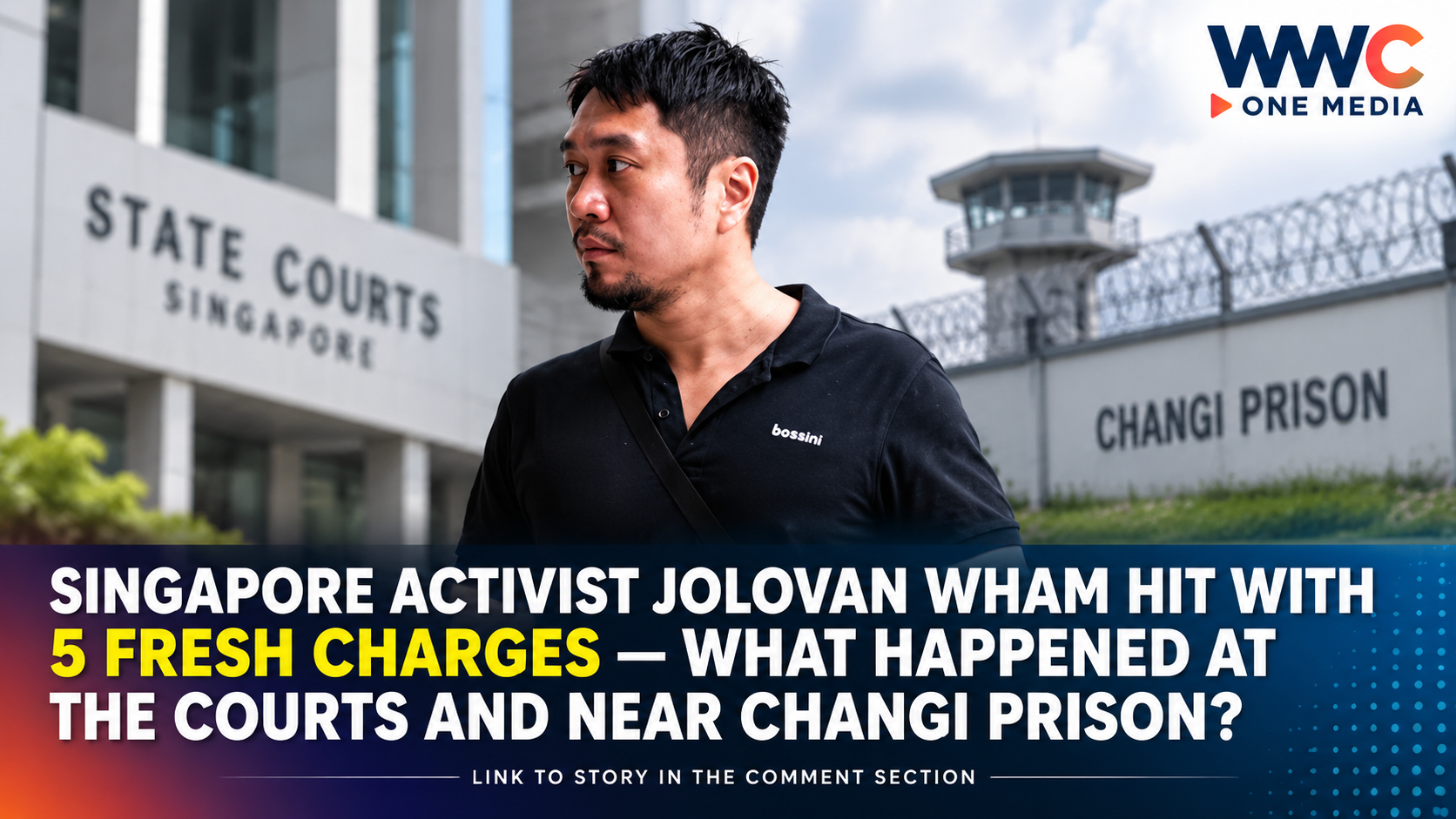
SINGAPORE — Civil rights activist Jolovan Wham has been handed five fresh charges in Singapore, adding a new chapter to his long-running legal battles over public assemblies and candlelight vigils linked to opposition to the death penalty.
Wham, 46, appeared at the State Courts on Monday, September 7, 2026, where he was charged over allegations that he organised an assembly at the State Courts, attended several candlelight vigils near Changi Prison and refused to answer questions during a police investigation.
The latest charges come as Wham continues to face other pending legal proceedings connected to public assemblies and his activism.
What Are the New Charges Against Jolovan Wham?
According to court proceedings reported by CNA, Wham is accused of organising a public assembly at about 10.20am on February 3, 2025, at the State Courts.
The alleged assembly was intended to publicise the cause of abolishing capital punishment in Singapore. The State Courts is classified as a prohibited area under Singapore's public order laws.
Wham was also charged over his alleged participation in three candlelight vigils held near Changi Prison on:
- November 22, 2024
- November 29, 2024
- January 23, 2025
The vigils were held to mark the executions of inmates.
A separate charge alleges that Wham refused to answer questions from a police officer when he was questioned on November 28, 2024, in connection with a vigil held several days earlier.
The case has been adjourned for a pre-trial conference later this month.
What Penalties Could He Face?
If convicted of organising a public assembly in a prohibited area, Wham could face:
- Up to six months in jail
- A fine of up to S$10,000
- Or both
For allegedly refusing to answer questions from an authorised public servant, he could face:
- Up to six months in jail
- A fine of up to S$5,000
- Or both
For allegedly taking part in a public assembly without the required permit, the maximum penalty is a fine of up to S$5,000.
As with all criminal proceedings, the charges remain allegations unless and until proven in court.
Wham Was Previously Fined Over Candlelight Vigils
The fresh charges follow an earlier case involving candlelight vigils near Changi Prison.
Wham was fined a total of S$10,500 in May 2026 after being convicted of Public Order Act offences connected to vigils marking the executions of inmates.
CNA had previously reported that Wham was charged in February 2025 over five alleged unlawful candlelight vigils held in 2022 and 2023 to mark the executions of death row prisoners.
Two other charges connected to public assemblies in 2022 were also already pending against him before Monday's latest charges.
A Long History of Legal Battles
The latest case is not Wham's first confrontation with Singapore's public assembly laws.
Over the years, he has faced multiple cases related to protests, assemblies and other acts of civil activism.
In 2021, Wham served a jail sentence after choosing imprisonment instead of paying the full amount of a fine imposed over an unauthorised public assembly on an MRT train.
Earlier cases also involved a candlelight vigil outside Changi Prison and an assembly linked to the commemoration of Operation Spectrum.
Singapore authorities have maintained that public assemblies must comply with the country's laws, including permit requirements and restrictions involving prohibited areas.
Human Rights Groups Call for Charges to Be Dropped
The latest developments have also renewed attention on the broader debate over freedom of peaceful assembly in Singapore.
In April 2026, Amnesty International, Human Rights Watch, FORUM-ASIA and CIVICUS issued a joint call for Singapore to drop charges against Wham related to peaceful gatherings.
The organisations argued that the cases raised concerns about restrictions on freedom of expression and peaceful assembly.
Singapore's legal framework, however, places restrictions on public assemblies, including permit requirements and additional rules governing certain locations.
The contrasting positions highlight the continuing debate surrounding public protest, civil disobedience and capital punishment in the city-state.
Why the Case Is Drawing Attention
Wham's latest charges are significant not only because of the number of allegations involved but also because they sit at the intersection of two contentious issues in Singapore: the right to public assembly and the country's continued use of the death penalty.
Supporters and international rights groups have framed the vigils as peaceful expressions of opposition to capital punishment.
Singapore authorities, meanwhile, enforce laws governing public assemblies and restricted locations, with breaches potentially resulting in criminal penalties.
With five fresh charges now added to his legal battles, the activist's next court appearance is expected to draw renewed attention to one of Singapore's most closely watched debates over protest and public order.
The question now is what happens next — and whether Wham's latest court battle will once again put Singapore's public assembly laws and death penalty policies under the international spotlight.
WWC ONE MEDIA J.M.S