
Singapore and Thailand Map Out Bigger ASEAN Agenda as Wong and Anutin Put AI, Food Security and Connectivity at the Centre

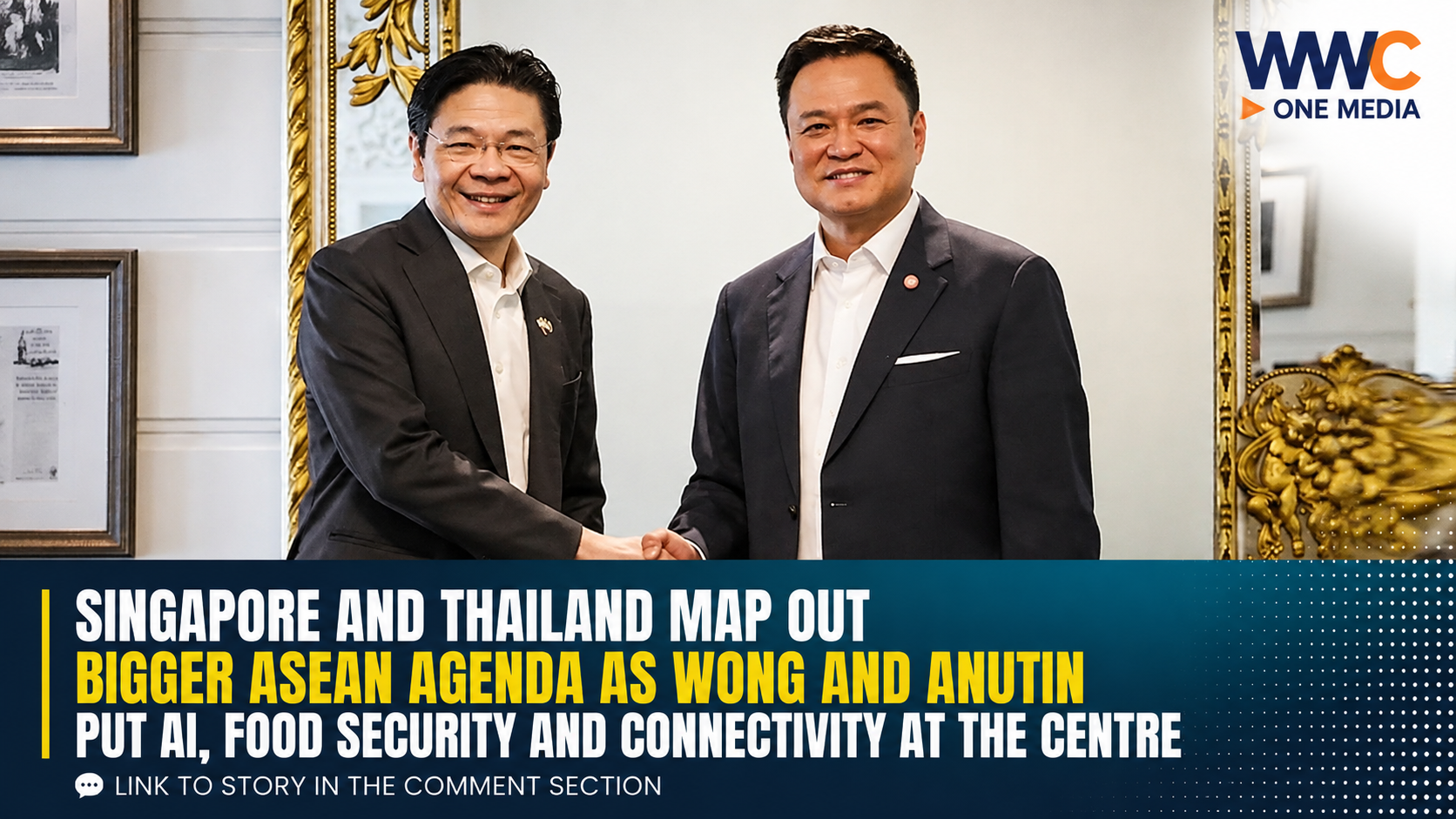
Singapore and Thailand are preparing to work more closely on the next phase of ASEAN cooperation, with their leaders agreeing to develop a multi-year agenda linking their consecutive ASEAN chairmanships in 2027 and 2028.
Singapore Prime Minister Lawrence Wong and Thai Prime Minister Anutin Charnvirakul reached the agreement during their first Singapore-Thailand Leaders’ Retreat in Bangkok on Sept. 2, 2026. The meeting also revived the leaders’ retreat after an 11-year hiatus, with the previous one held in 2015.
The discussions went well beyond traditional diplomacy, covering artificial intelligence, food and energy security, digital connectivity, trade, investment, defence, cybersecurity and transnational crime.
The Bigger Story: Singapore and Thailand Want ASEAN Continuity
Singapore will take over the ASEAN chairmanship in 2027, followed by Thailand in 2028.
That creates an unusual opportunity for the two neighbouring economies to pursue initiatives that require more than a single year to complete.
Wong said the two countries are “like-minded partners” with a shared interest in a strong and united ASEAN. Their governments will now work on a multi-year agenda designed to maintain momentum from Singapore's chairmanship into Thailand's.
The joint statement says the two sides want closer coordination toward the ASEAN Community Vision 2045, while supporting an open, rules-based and inclusive regional architecture.
This could make the Singapore-Thailand relationship an important bridge between two successive ASEAN presidencies.
AI Moves From Talk to Practical Cooperation
Artificial intelligence emerged as one of the most forward-looking areas of the discussions.
Both Singapore and Thailand are investing heavily in AI and want to explore practical applications rather than simply discussing the technology at a policy level.
Wong identified potential cooperation in sectors where both countries already have strong capabilities, including:
- Manufacturing
- Healthcare
- Tourism
- Digital services
- AI research and development
- Talent development
- AI governance
The two governments also agreed to share experience on safe and responsible AI deployment, while continuing to encourage innovation and adoption.
The joint statement specifically calls for cooperation on AI ecosystems, adoption, governance, talent development and R&D. It also highlights the importance of regional cooperation as competition among major powers in AI intensifies.
Food Security: Thailand Wants to Be Singapore's Trusted Partner
Food security was another major priority.
Singapore imports the vast majority of its food, making reliable international supply chains strategically important.
Thailand, meanwhile, is one of the region's major agricultural producers.
The two leaders agreed to accelerate implementation of their 2025 rice-trade cooperation agreement and explore additional areas of food-security cooperation. Thailand reaffirmed its readiness to serve as a trusted partner for Singapore's food supply.
Thai officials have previously said the rice arrangement could support the supply of up to 100,000 tonnes of Thai rice to Singapore over five years, upon Singapore's request and at prevailing international market prices.
The latest discussions also seek to strengthen links between Thai food producers and Singapore's trading and logistics networks.
That gives both sides a practical reason to deepen their relationship: Thailand has production capacity, while Singapore is a major regional logistics and trading hub.
Energy Security Is Becoming More Urgent
Energy resilience is also moving higher up the bilateral agenda.
The two countries agreed to work toward stronger energy security, including through the ASEAN Power Grid and greater cooperation on carbon markets.
Singapore and Thailand, together with Laos and Malaysia, are already involved in the Lao PDR–Thailand–Malaysia–Singapore Power Integration Project, which is an important step toward wider regional electricity trading.
The leaders also agreed to explore cooperation in areas including:
- Hydrogen
- Carbon capture, utilisation and storage
- Low-carbon technologies
- Green finance
- Renewable energy
The push comes as geopolitical conflicts and supply-chain disruptions continue to expose vulnerabilities in global energy markets.
Singapore Could Help Thailand Become a Bigger Regional Logistics Hub
Physical and digital connectivity are another major piece of the emerging partnership.
Thailand wants to strengthen its position as a regional trade and logistics hub, including by improving infrastructure and connections between industrial centres, transport networks and ports.
Wong said Singapore could be a natural partner, pointing to the capabilities of Singapore companies such as PSA in logistics and port operations.
The two sides also want to strengthen digital connectivity and expand cooperation in fintech and the wider digital economy.
Their existing PayNow-PromptPay linkage, launched in 2021, was the world's first connection between two national real-time payment systems. The next step is to expand regional connectivity through Nexus Global Payments.
For consumers and businesses, the long-term goal is a Southeast Asia where cross-border payments, trade and investment become easier and more integrated.
Trade and Investment Remain at the Core
The relationship is already economically significant.
CNA reported that bilateral trade reached approximately S$52.4 billion (US$41.1 billion) in 2025, representing an increase of 17.8 per cent from the previous year.
Singapore was Thailand's largest source of foreign direct investment, at about US$17.57 billion, according to CNA's report ahead of the retreat.
At the latest meeting, both governments agreed to deepen trade and investment ties, strengthen supply-chain resilience and encourage investment in areas including:
- Semiconductors
- Logistics
- Renewable energy
- Sustainability
- Digital industries
Thailand also welcomed further Singapore investment as it seeks to develop higher-value industries.
Defence and Online Scams Are Also Part of the Agenda
The relationship is not purely economic.
Singapore and Thailand reaffirmed their longstanding defence cooperation, including military exercises, training, information sharing and professional exchanges.
The countries also agreed to explore deeper cooperation in defence industries, supply-chain resilience and cybersecurity.
Another growing concern is transnational crime, particularly online scams and financial crime.
The two governments plan to cooperate on investigations, prevention, information sharing, capacity building and possible joint operations, including issues involving digital assets.
This is significant as both countries become increasingly digital and cross-border financial crime becomes harder to tackle through national enforcement alone.
A New Social Cooperation Agreement
The leaders also witnessed the signing of a memorandum of understanding on social sector development.
The agreement covers areas such as:
- Exchange of personnel
- Sharing research and policy experience
- Visits to social-service institutions
- Workshops and training
- Cooperation involving families, women, children, older people and persons with disabilities
CNA reported that Singapore's Minister for Social and Family Development Masagos Zulkifli and Thailand's Social Development and Human Security Minister Nikorn Soemklang signed the agreement.
Why This Matters for ASEAN
The most important development may not be any single agreement.
It is the decision by Singapore and Thailand to coordinate their ASEAN chairmanships across two consecutive years.
Singapore will chair ASEAN in 2027 as the organisation marks its 60th anniversary, before Thailand takes over in 2028.
If the two countries can carry initiatives from one chairmanship into the next, projects involving AI, digital payments, energy, food security, supply chains and regional connectivity could receive longer-term policy continuity.
That does not mean Singapore and Thailand will control ASEAN's agenda. ASEAN decisions remain dependent on the wider membership.
But the two countries now have an opportunity to build momentum together at a time when Southeast Asia faces increasing pressure from geopolitical competition, economic fragmentation, energy uncertainty and technological disruption.
The question is whether the ambitious plans announced in Bangkok can move from joint statements to projects that ordinary businesses and people actually feel.
Accuracy Note
The Sept. 2 meeting was the fifth Singapore-Thailand Leaders' Retreat and the first since 2015. The leaders agreed to develop a multi-year ASEAN agenda because Singapore will chair ASEAN in 2027 and Thailand in 2028. The AI, food security, energy, connectivity and security initiatives described above are areas of agreed cooperation or exploration, not evidence that all projects have already been implemented.
The reported 100,000-tonne rice figure relates to the earlier 2025 Thailand-Singapore rice arrangement; the latest joint statement says the two sides will expedite implementation and explore further food-security cooperation.
WWC ONE MEDIA J.M.D