
Singapore Tech Acquisitions Hit 11 as IPOs Disappear — But Billions Are Still Pouring Into Startups

SINGAPORE — September 4, 2026 — Singapore’s technology sector is showing two very different faces.
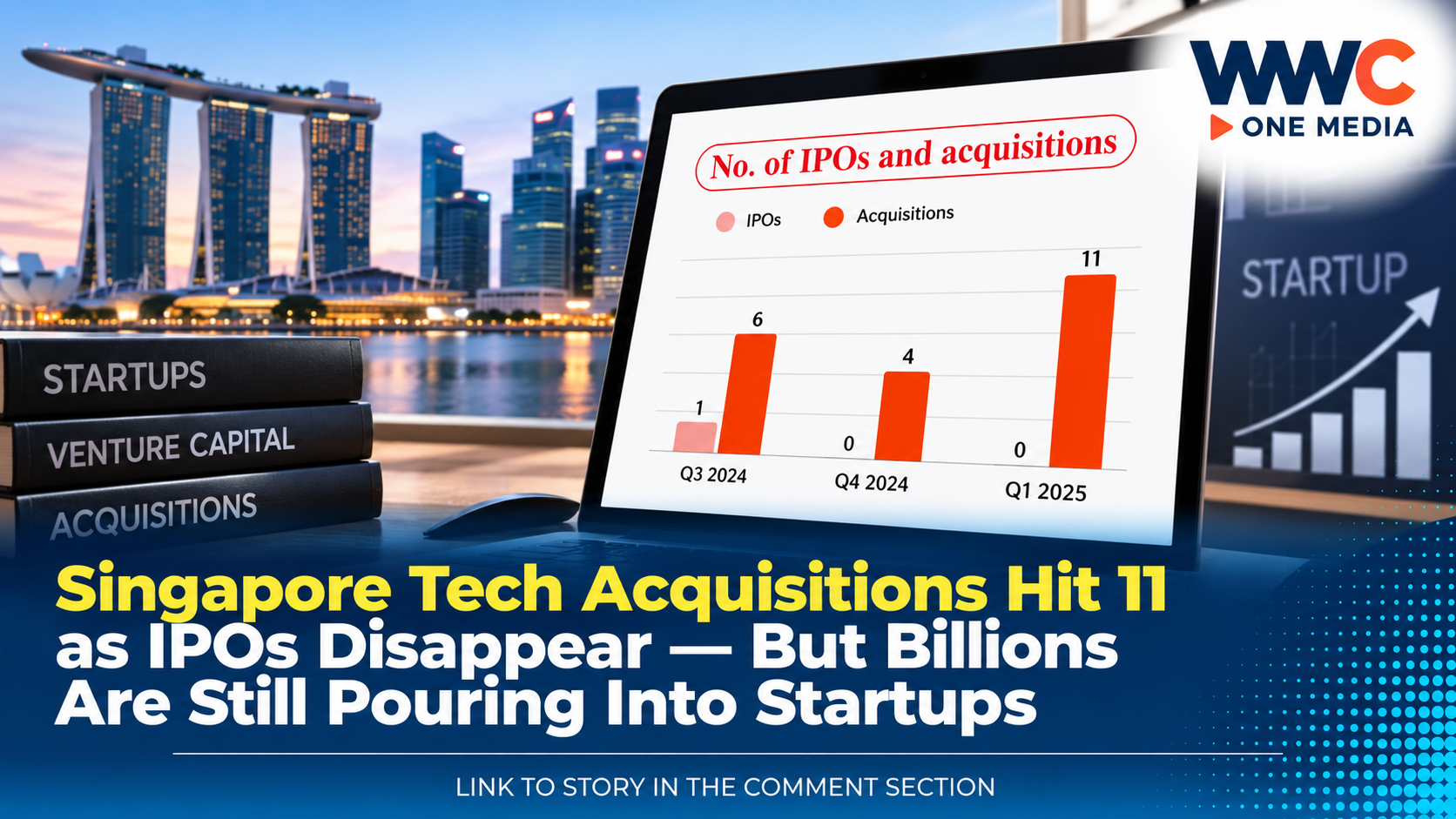
On one side, acquisition activity accelerated, with 11 tech companies completing acquisitions during Tracxn’s Q3 2026 reporting window.
On the other, the sector recorded no IPOs and no new unicorns during the period.
The contrast is striking: investors are still committing billions of dollars to Singapore’s technology ecosystem, but startups appear to be finding exits and capital through private transactions rather than public-market listings.
According to Tracxn data cited by Singapore Business Review, the sector completed 11 acquisitions between July 1 and August 26, up from six in the previous quarter and eight in Q3 2025.
Q2 2026 recorded one IPO, while Q3 2025 produced three.
That makes the latest figures a significant change in the way Singapore’s technology companies are raising capital and creating liquidity for early investors.
Acquisitions rise while IPOs disappear
The increase in acquisitions could initially look like a positive sign for Singapore’s startup ecosystem.
It means technology companies are still attracting strategic buyers and investors are still finding opportunities to deploy capital.
But the absence of IPOs tells a different story.
Public listings provide companies with access to a wider pool of capital while giving founders, employees and early investors a route to liquidity. A prolonged absence of listings can therefore leave private acquisitions and secondary transactions carrying more of the burden.
The trend also comes against a backdrop in which Singapore has been trying to strengthen its position as a regional equity-market hub.
Earlier in 2026, expectations for Singapore's IPO market were considerably more optimistic. However, by July, only six companies had listed on the SGX, with five trading below their IPO prices as of July 23, according to CNA.
Analysts cited thin liquidity, investor preferences for AI-related companies and global market conditions among the factors weighing on Singapore's listing environment.
Yet technology funding is booming
Here is where the numbers become more surprising.
Singapore’s technology companies raised US$4.8 billion in equity funding during Tracxn’s Q3 reporting period.
That was a 21.09% increase from US$4 billion in Q2 and a massive 115.64% increase from US$2.2 billion in Q3 2025.
In other words, the absence of IPOs does not mean investors have abandoned Singapore’s technology sector.
Quite the opposite.
Capital is still flowing in — but it is heavily concentrated in a handful of very large funding rounds.
One AI deal dominates the quarter
Kling AI was the standout funding story.
The AI video-generation business raised US$2.8 billion, accounting for more than half of Singapore's total tech funding during the Tracxn period.
It was followed by:
- Ant International — US$1.2 billion
- CRYPTO — US$400 million
- Acrab AI — US$130 million
- dConstruct Robotics — US$125 million
The size of the top two deals alone illustrates how heavily the headline funding figure was influenced by late-stage capital.
Kling AI’s funding was reported separately as more than RMB19 billion, or about US$2.8 billion, with investors including Alibaba and Tencent. The funding valued the AI video business at approximately US$15 billion on a pre-money basis.
Ant International's US$1.2 billion raise sends another signal
Ant International also completed a US$1.2 billion Series A financing in July.
The Singapore-based fintech said the capital would support expansion in merchant payments, account management and other financial services for small businesses and enterprises.
The company operates globally through businesses including Alipay+, Antom, WorldFirst and Bettr.
The fundraising is particularly notable because Ant International has increasingly been positioned as a standalone global financial technology business, with the potential for a future listing having been discussed by market sources.
The company subsequently expanded its AI push in August, announcing partnerships involving major banks including Citi, HSBC, Deutsche Bank, Standard Chartered and Barclays for its specialised financial AI technology.
Late-stage investors are dominating the capital pool
Another major takeaway from the Tracxn data is where the money is going.
Late-stage funding accounted for 67.2% of Singapore's overall tech funding during the Q3 reporting period.
Early-stage funding represented 32.1%, while seed-stage funding accounted for just 0.7%.
That represents a shift from Q2, when late-stage funding accounted for 83.5%, early-stage funding 14.7% and seed-stage funding 1.8%.
Compared with Q3 2025, however, the latest mix is not dramatically different: late-stage funding represented 70.6% of funding then, versus 26.8% for early-stage and 2.6% for seed.
The message is clear: Singapore's technology capital market is increasingly rewarding companies that have already reached significant scale.
No new unicorns despite billions in funding
Perhaps the most revealing number is the one that is missing.
No new unicorns were created during the reporting period.
That means the surge in funding did not translate into a fresh wave of startups reaching the US$1 billion private valuation threshold.
This is important because unicorn creation is often used as a shorthand measure of whether an ecosystem is producing a new generation of highly valued technology companies.
Instead, much of the available capital appears to be flowing into established or later-stage businesses — including very large AI and fintech transactions.
Singapore's biggest tech challenge may now be exits
The combination of stronger acquisitions, heavy late-stage funding and zero IPOs raises a bigger question:
Where do investors ultimately get their exits?
An acquisition can provide a direct liquidity event for founders and investors. But IPOs offer another important path, particularly for larger technology companies seeking long-term access to public capital.
Singapore’s relatively thin equity-market liquidity has already been identified by analysts as a structural challenge.
CNA reported in July that five of the six companies listed in Singapore during the year were trading below their IPO prices at that point. Analysts warned that weak aftermarket performance could make companies more cautious about listing and investors more selective about new offerings.
That creates a potentially important feedback loop.
If companies believe private funding or acquisition offers better outcomes than an SGX listing, fewer technology businesses may choose the public-market route.
Fewer attractive technology listings could then make it harder for Singapore to build the deep technology-investor base needed to support future IPOs.
But the IPO story is not necessarily over
The current numbers should not be interpreted as proof that Singapore's IPO market is permanently broken.
EY said global IPO markets had gained momentum in the first half of 2026, although listing windows remained vulnerable to geopolitical developments, interest-rate expectations and market volatility.
Companies are also increasingly keeping their options open between traditional IPOs, direct listings and SPAC structures.
Singapore has also been pursuing reforms intended to improve the attractiveness of its equity market.
Analysts cited by CNA said a broader pipeline, stronger post-listing performance and greater liquidity would be more meaningful measures of progress than simply counting IPOs in a single quarter.
The real story behind Singapore's Q3 tech numbers
The latest Tracxn figures do not show a technology sector running out of money.
They show something more complicated.
Private capital remains highly interested in technology — particularly AI, fintech and other late-stage opportunities — while public-market exits remain much harder to achieve.
The 11 acquisitions demonstrate that strategic buyers are still active.
The US$4.8 billion funding total demonstrates that investors are still willing to write enormous cheques.
But zero IPOs and zero new unicorns suggest that the ecosystem is becoming more selective about which companies receive capital and how investors ultimately realise their returns.
For Singapore, that could make the next phase of its technology strategy less about simply attracting more startup money and more about creating successful companies that can scale, exit and ultimately thrive in public markets.
Because the money is clearly there.
The bigger question is whether Singapore can turn that capital into the next generation of technology companies large enough — and attractive enough — to stay independent, go public or become major regional champions.
WWC ONE MEDIA J.M.D