
Singapore’s PM Warns Racist Backlash Is Crossing a Dangerous Line — But the Trigger Wasn’t Just the Nepal Disaster

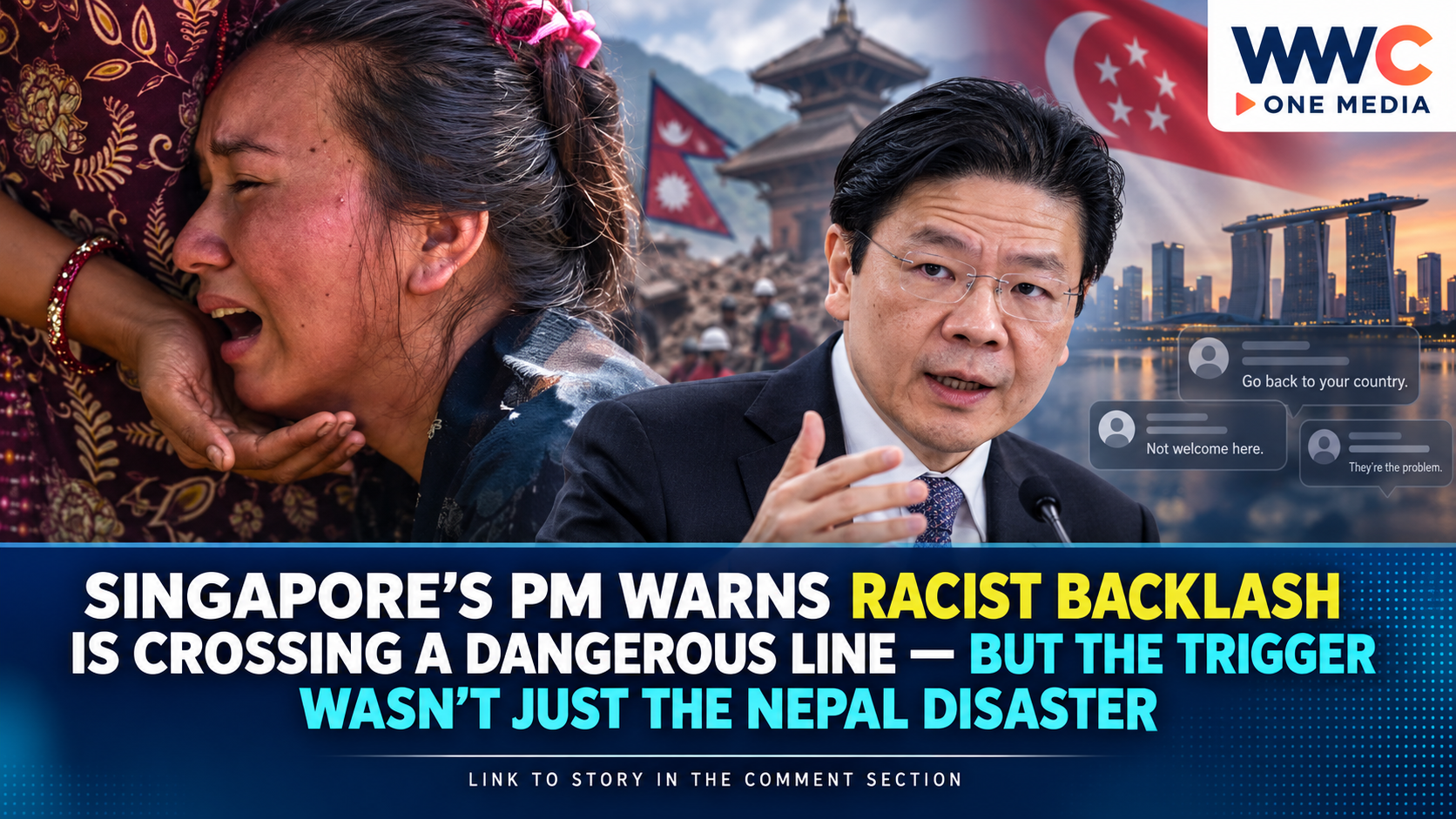
SINGAPORE — A humanitarian disaster thousands of kilometres away and a controversial multibillion-dollar airline investment have collided in Singapore in an unexpected way.
And Prime Minister Lawrence Wong says what is happening online should not be dismissed as harmless internet noise.
After racist remarks targeted some of the nine Singaporeans still missing in the devastating Nepal-Tibet floods, and anti-Indian abuse became mixed into arguments over Singapore Airlines’ investment in Air India, Wong issued a blunt warning on Sunday:
Singapore must never allow prejudice against any community to become accepted or normalised.
“We can and should have robust debates,” Wong said, but such debates should never become a cover for hostility toward racial communities or foreigners.
His intervention came one day after Senior Minister and Home Affairs Minister K Shanmugam said police had begun looking into what he described as “shameful” and “totally unacceptable” racist and xenophobic online comments.
The Ministry of Digital Development and Information is also expected to ask social-media platforms to remove content that breaches their guidelines.
But behind the immediate controversy is a much bigger question for one of Asia’s most deliberately multiracial societies:
When does anger over immigration, corporate decisions or national identity stop being political debate — and start becoming racial hostility?
Nine Singaporeans Are Missing — Yet Some Online Users Questioned Whether They Were Really ‘Our Own’
The first flashpoint was the catastrophic flooding that struck the Nepal-Tibet border region in late August.
By early September, more than 1,200 people had been confirmed dead, thousands remained missing and nine Singaporeans were still unaccounted for. Singapore sent police and forensic specialists to Nepal to assist with search, recovery and disaster-victim identification.
Yet as families waited for news, racist comments began appearing beneath social-media reports about the missing Singaporeans.
Some users suggested that Singaporeans of Indian ethnicity should somehow be regarded as less Singaporean. Others used derogatory stereotypes about Indians.
Shanmugam said the comments crossed a line.
His concern was not simply that individual remarks were offensive.
It was what happens when they become routine.
First, he argued, such language appears among a minority. Then it becomes normalised. Eventually, political and community figures may repeat it, degrading public discourse and making hostility between racial groups increasingly acceptable.
Wong echoed that concern a day later.
He said such comments do not represent Singapore as a whole, but warned against treating them as insignificant because unchecked prejudice can deepen mistrust and pull communities apart.
The Public Response Tells a Very Different Story
The racist comments have attracted attention precisely because they contrast so sharply with the wider public reaction to the disaster.
By September 3, the Singapore Red Cross had raised more than S$3 million through its Nepal floods appeal.
It also committed additional funding for food assistance, water filtration and other emergency relief, while the Singapore government provided seed funding and later assembled a humanitarian package worth roughly S$560,000 containing medical supplies, DNA-testing materials, protective equipment and specialist search-and-recovery equipment.
Shanmugam pointed to that response as evidence that the people making racist comments are a minority.
His warning was that a minority can still do disproportionate damage if its rhetoric is repeatedly amplified online.
Then Air India Became the Second Flashpoint
The controversy might have remained focused on the Nepal disaster.
Instead, another emotionally charged issue arrived almost simultaneously.
Reuters reported in late August that Air India was seeking approximately US$1.5 billion in new equity from its owners, Tata Sons and Singapore Airlines, as the carrier continued an expensive restructuring while suffering heavy losses.
Singapore Airlines owns 25.1% of Air India, with Tata owning the remainder.
Air India and its budget operation had recorded combined losses of about US$2.33 billion for the financial year ending in March, more than twice the previous year's loss, according to Reuters.
That inevitably raised legitimate questions in Singapore.
How much additional capital might SIA eventually have to contribute?
How long will Air India's turnaround take?
And will the strategic benefits of accessing one of the world's fastest-growing aviation markets justify the financial exposure?
Those are commercial questions.
And Wong's government has not argued that Singaporeans should stop asking them.
Kenneth Tiong Says His Questions Are ‘Purely Commercial’
Workers' Party MP Kenneth Tiong had publicly questioned SIA's exposure to Air India and how repeated requests for additional funding could affect the Singapore carrier.
After Shanmugam spoke about the racist backlash surrounding the Air India debate, Tiong responded that “there is no place for racism in our society.”
He said his concerns regarding SIA's investment were “purely commercial” and condemned attacks on people's motives because of ethnicity.
That distinction matters.
Shanmugam himself said Tiong was entitled to question the commercial decision.
His broader point was that SIA is a publicly listed company accountable to its shareholders, and that its management and board — rather than politicians — must ultimately decide whether an additional Air India investment makes financial and strategic sense.
The controversy therefore involves two separate things that should not be conflated:
Criticism of the Air India investment can be legitimate.
Attacking the ethnicity of executives or using anti-Indian stereotypes is something entirely different.
Temasek Says the Air India Bet Is Long-Term
The debate has become especially sensitive because Temasek is SIA's majority shareholder.
Temasek has defended SIA's Air India strategy from a long-term perspective, even while acknowledging the complexity of turning around the Indian carrier.
The investment gives SIA exposure to India's enormous and rapidly expanding aviation market, and SIA has said it will assess future capital requirements carefully.
But critics point to Air India's heavy losses and the possibility that shareholders may be asked for more money.
That commercial debate is unlikely to disappear.
The more troubling development, Shanmugam said, was that some online users began attacking Temasek CEO Dilhan Pillay Sandrasegara based on his Indian ethnicity, suggesting that his race explained support for Air India.
Shanmugam rejected that argument as both racist and defamatory, saying ethnicity cannot be used as evidence that an executive is acting against Singapore's interests.
Wong: Debate Hard, But Don’t Turn Race Into the Argument
This may be the most important part of Wong's intervention.
He was not demanding that Singaporeans stop disagreeing.
He was drawing a boundary around how disagreements are framed.
Singaporeans can challenge immigration policy.
They can question foreign investment.
They can scrutinise Temasek.
They can ask whether SIA's strategy is financially sound.
But Wong warned against taking those debates and attaching assumptions about loyalty, competence or national belonging to someone's ethnicity.
That distinction becomes increasingly important in the social-media era, where legitimate concerns can be rapidly mixed with racial stereotypes until it becomes difficult to separate the original policy argument from the prejudice surrounding it.
Singapore Has Seen This Pattern Before
Wong said the latest controversy is not unprecedented.
He pointed to racial and anti-foreigner tensions that surfaced during the COVID-19 pandemic, debates surrounding the Singapore-India Comprehensive Economic Cooperation Agreement, or CECA, and attempts to bring race and religion into political discussion during the 2025 general election.
Singapore's government has historically treated racial harmony as an issue of national security, not simply social etiquette.
That approach reflects the country's demographics and history.
Singapore's Chinese, Malay, Indian and other communities live inside an exceptionally small and densely populated state, while a large foreign workforce adds another layer to debates over immigration, employment and identity.
The government's position is that if racial identity becomes the default explanation for political or economic disagreements, Singapore's social cohesion could erode very quickly.
There Is Also an Overseas Influence Dimension
Shanmugam added another important element: not all of the recent anti-Indian material necessarily originated in Singapore.
He said some racial narratives had originated or been amplified overseas.
That concern is not hypothetical.
In June 2026, Singapore authorities ordered YouTube, Facebook and X to restrict access to several posts targeting the Indian community.
The Ministry of Home Affairs said some narratives had emerged from the Chinese-language information space and portrayed Singapore as being “overrun” by Indians, accused Indian politicians of favouring immigrants and attacked the country's multiracial model.
Authorities assessed that the posts were likely to violate Singapore's law against knowingly promoting racial enmity.
That earlier episode provides important context for why ministers are now reacting so forcefully.
The concern is not merely one ugly Facebook comment.
It is the possibility that domestic frustrations can be amplified by organised or viral narratives that portray one ethnic group as a threat to everyone else.
Police Are Investigating — But That Does Not Mean Everyone Who Posted an Offensive Comment Has Committed a Crime
Accuracy matters here.
Shanmugam said he had asked police to look into the comments.
That is not the same thing as announcing arrests, charges or convictions.
Singapore's Penal Code does contain specific race-related offences.
Section 298 deals with words or acts made with deliberate intent to wound racial feelings, while Section 298A addresses knowingly promoting racial disharmony, hatred or ill will, or conduct prejudicial to racial harmony that disturbs or is likely to disturb public tranquillity.
A Section 298A offence can carry up to three years' imprisonment, a fine, or both.
But whether any individual post meets those legal thresholds is a matter for investigators and, if charges are eventually filed, the courts.
So the correct description is that police are examining the posts — not that every person who made a racist remark has already committed a criminal offence.
Singapore’s Online-Harms Powers Have Expanded
The government also possesses growing powers to deal with problematic content online.
Under the Online Criminal Harms Act, authorities can require platforms to disable access to content assessed to be connected with specified criminal offences.
Those powers were used in June against content targeting Singapore's Indian community.
Separately, Singapore's new Online Safety Commission began operating in June 2026, creating additional avenues for people harmed by certain forms of online content to seek relief.
Those measures illustrate how seriously Singapore is treating the online environment as a potential source of real-world social harm.
Lee Hsien Loong Also Stepped In
Wong was not the only senior political leader to respond on Sunday.
Senior Minister Lee Hsien Loong described the anti-Indian comments as “deeply troubling” and urged Singaporeans to stand together regardless of race, language or religion.
He warned that race and religion will always remain potential fault lines because human beings are not completely “race blind.”
For Lee, that means political and community leaders cannot simply wait for inflammatory rhetoric to disappear.
They have to challenge it.
His message closely echoed Wong's:
Singapore's racial harmony is not something that maintains itself automatically.
Why This Moment Matters More Than a Few Online Comments
At first glance, the two controversies appear unrelated.
One concerns Singaporeans missing after a catastrophic natural disaster.
The other concerns whether a national airline should continue investing billions in an Indian carrier.
Yet they became linked online through one common factor:
Indian ethnicity.
That is precisely what worries Singapore's leaders.
If every controversy involving an Indian Singaporean, an Indian company or India itself becomes an opportunity to question the loyalty or legitimacy of Singapore's Indian community, then commercial and political debates risk becoming racial debates.
And once that happens, the argument is no longer really about an airline investment.
Nor is it about flood-rescue spending.
It becomes an argument about who counts as Singaporean.
Wong's answer is clear.
Singaporean identity, he said, must remain “open and inclusive.”
People of different backgrounds who embrace Singapore's shared values and way of life belong to the nation.
The Real Test Comes After the Hashtag Dies
Most online controversies disappear quickly.
The posts stop trending.
Comments sections move on.
Another issue takes over.
But Wong's warning is aimed at what can remain behind.
Repeated racial narratives can slowly redefine what people consider acceptable.
A joke becomes a stereotype.
A stereotype becomes an assumption.
An assumption becomes a political argument.
And eventually, a citizen may be judged less by what he or she does than by race.
Singapore's government is signaling that it wants to interrupt that process early.
The Air India investment can still be challenged.
Government policy can still be criticised.
Immigration can still be debated.
But Wong says one boundary should remain clear:
No Singaporean's race should determine whether that person belongs.
That may be why the controversy surrounding a disaster in Nepal and an airline deal in India has suddenly become a national conversation about Singapore itself.
WWC ONE MEDIA M.J.E