South Korea's Household Loans Finally Fall After 6 Months — But the Debt Problem Isn't Over Yet

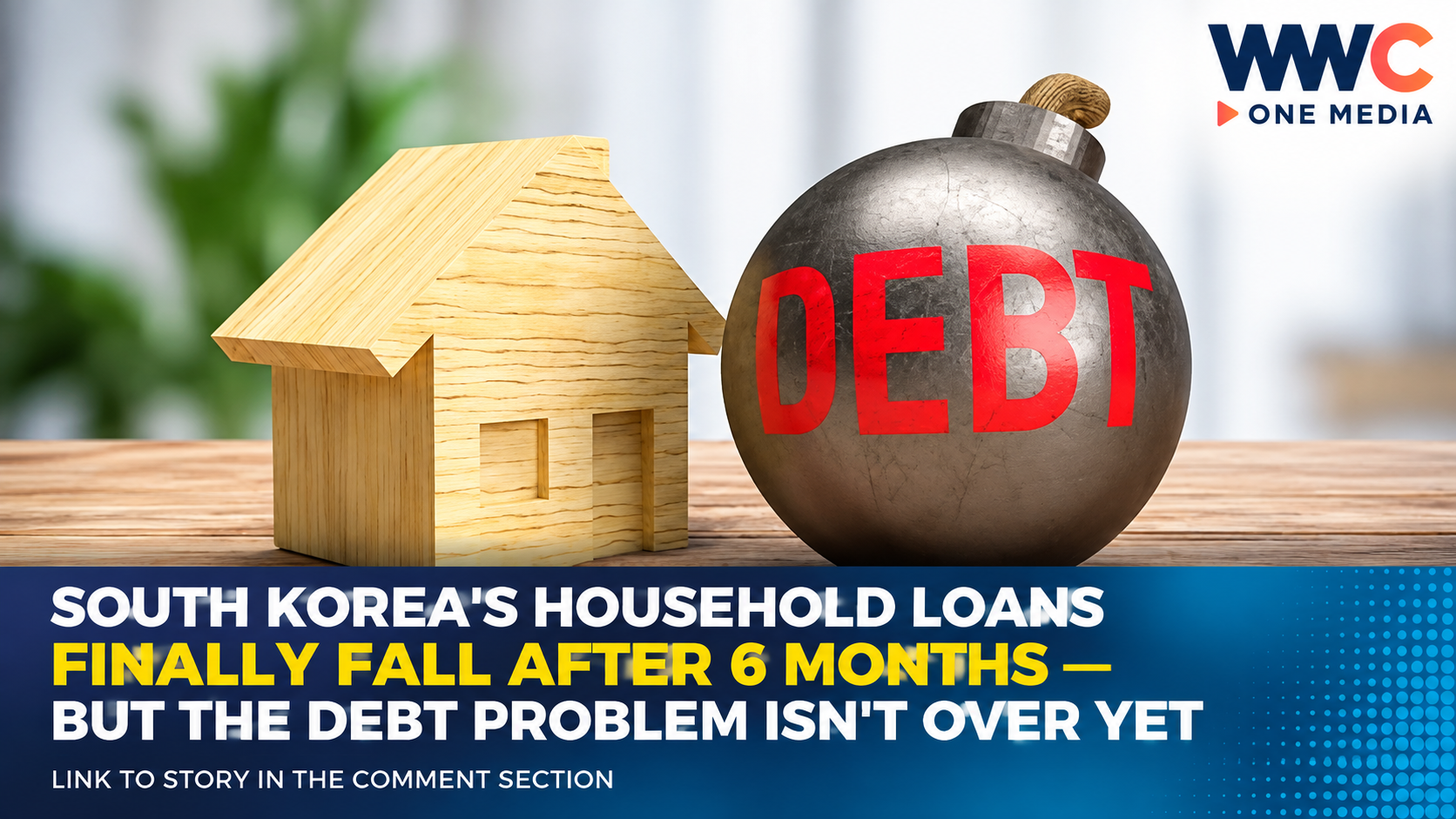
South Korea’s major banks have recorded their first monthly decline in household loans in six months, signaling that tighter lending controls are beginning to put the brakes on borrowing even as demand for mortgages remains strong.
The combined household-loan balance at the country’s five largest commercial banks — KB Kookmin, Shinhan, Hana, Woori and NH NongHyup — stood at 781.39 trillion won ($580.49 billion) as of Sept. 3, down 727.6 billion won from the end of August, according to data compiled by the banks and reported by The Korea Herald and Yonhap.
The decline is the first since March and comes despite the government's recent decision to loosen its overall household-loan growth ceiling.
Banks are still keeping borrowers on a tight leash
The latest numbers suggest that regulatory easing has not immediately translated into easier access to credit.
Industry officials said banks continue to impose their own lending restrictions, limiting how quickly new household loans can grow. The five major lenders have reportedly received additional room from financial authorities, raising their combined annual household-loan growth target from 4.3 trillion won in 2025 to about 7.1 trillion won this year.
But the additional quota does not mean banks are opening the floodgates.
Earlier data showed that the five banks were already approaching their revised lending limits. Seoul Economic Daily reported in late August that the banks' combined household-lending growth target had been increased to about 6.98 trillion won, but only around 310 billion won of additional capacity remained under the relevant controls at that point.
That helps explain why borrowers may still find it difficult to secure ordinary mortgages or unsecured loans despite the government's policy adjustment.
Mortgage loans also edged lower
Mortgage lending was not immune to the latest pullback.
Outstanding mortgage loans at the five banks fell to 620.5 trillion won as of Sept. 3, compared with 621.2 trillion won at the end of August.
That decline is notable because mortgage demand had been one of the main forces pushing household borrowing higher in previous months.
At the end of August, mortgage balances had jumped by more than 3 trillion won during the month, with group loans tied to apartment developments recording particularly strong growth.
The latest figures therefore suggest that the lending restrictions are beginning to have a more visible effect on overall balances.
But the bigger household-debt problem hasn't disappeared
The monthly decline should not be mistaken for the end of South Korea's household-debt problem.
Bank of Korea data released in August showed that total household credit reached a record 2,019.8 trillion won at the end of June, after increasing by 25.9 trillion won during the second quarter.
Household loans accounted for 1,891.3 trillion won, while merchandise credit stood at 128.5 trillion won.
The second-quarter increase in household credit was the largest quarterly jump since the third quarter of 2021.
The Bank of Korea said the surge reflected stronger housing transactions as well as increased non-mortgage borrowing, including loans apparently linked to investment activity during the stock-market boom.
A temporary slowdown or the start of something bigger?
The latest decline raises an important question for South Korea's housing and financial markets.
Is household borrowing finally beginning to cool — or are banks simply reaching the limits of what they can lend under the current regulatory framework?
A local bank official cited by Yonhap said mortgage growth could regain momentum once loan supply resumes, particularly as collective lending for housing projects picks up.
That means the recent decline may not necessarily signal a sustained collapse in credit demand.
Instead, it could reflect a mismatch between strong demand for housing finance and banks' limited capacity to extend new loans.
Why apartment lending matters
Group loans are particularly important because they finance apartment developments and payments associated with newly completed housing projects.
Recent industry data showed group-loan balances at the five major banks increased by more than 1 trillion won in August, reaching roughly 149.3 trillion won. That was the biggest monthly increase for the category in 2026 at the time.
Authorities have subsequently moved to ease some restrictions surrounding group loans, while maintaining tighter controls over other forms of household borrowing.
This creates a two-speed lending market: financing connected to housing supply can receive more room, while ordinary borrowers seeking individual mortgages or unsecured credit may continue facing stricter conditions.
What it means for Korean households
For consumers, the latest figures point to a complicated reality.
Borrowing has not suddenly become easier simply because the government raised the overall lending target.
Banks remain cautious, and borrowers seeking individual mortgages or personal loans can still face tighter screening and limited availability.
At the same time, South Korea's household-debt burden remains exceptionally large, meaning policymakers face a difficult balancing act: support housing demand and economic activity without reigniting excessive household borrowing.
The September figures provide the first clear sign in months that tighter bank lending is having an impact.
But with housing demand still strong and household credit sitting near record levels, the bigger test may be just beginning.
If banks loosen the tap again, will South Korea's household debt surge back — or has the borrowing boom finally reached its limit?
WWC ONE MEDIA M.J.E