Taiwan and Rhode Island Renew Education Pact, Put AI and Chip Talent in the Spotlight

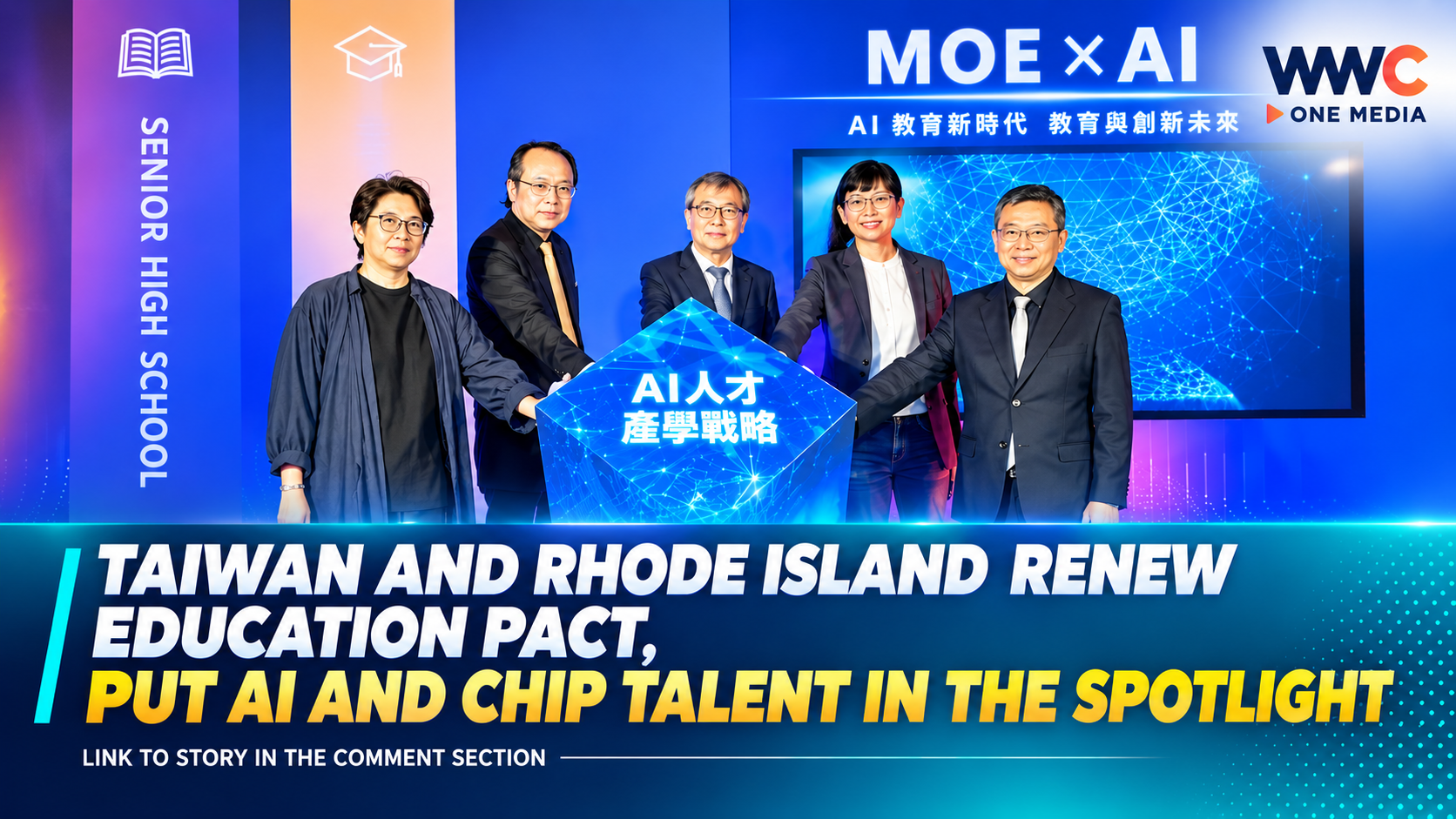
TAIPEI/PROVIDENCE — Taiwan and the U.S. state of Rhode Island have renewed their cooperation on postsecondary education, opening the door to deeper exchanges in language education, talent development, artificial intelligence and semiconductor-related fields.
The renewed memorandum of understanding (MOU) was signed on September 3, 2026, at the Rhode Island State House, with Rhode Island Gov. Dan McKee and Taiwan's representative to the United States Bi-khim Hsiao witnessing the signing. Taiwan's Ministry of Education International and Cross-Strait Education Department Director Li Yu-chuan and Rhode Island Commissioner of Postsecondary Education Shannon Gilkey represented the two sides at the signing.
The agreement extends an education partnership first established in July 2023, when Taiwan and Rhode Island signed their initial postsecondary education MOU. Taiwan's Education Ministry said that agreement was the first bilateral education cooperation agreement of its kind between Taiwan and a U.S. state in the New England region following the launch of the U.S.-Taiwan Education Initiative in 2020.
From classrooms to high-tech talent
The latest renewal comes as Taiwan and the United States increasingly focus on developing skilled workers in strategically important industries.
Hsiao said Taiwan's continuing investment in the United States and expanded educational exchanges can help train talent in AI and semiconductor supply chains, strengthening cooperation in areas that are becoming increasingly important to both economies.
The partnership is also expected to continue supporting Chinese-language education and student and academic exchanges.
Reporting from Boston Orange said the renewed agreement covers another three years and highlighted ongoing cooperation involving the University of Rhode Island (URI) and Brown University. Taiwan has supplied Chinese-language teachers and teaching assistants to institutions in Rhode Island, while URI has worked with Taiwan's Tunghai University on an immersion-based Chinese-language program.
That gives the agreement a broader reach than a traditional university exchange: the relationship connects language learning, academic mobility and workforce preparation.
Rhode Island sees Taiwan as an education partner
Gov. McKee said he has visited Taiwan twice and expressed admiration for its education system.
According to CNA, McKee said education has been a priority of his administration and that cooperation with Taiwan and Taiwan's representative office has supported educational programs benefiting Rhode Island students. He also pledged continued support for educational exchanges between the two sides.
The governor's comments come as Rhode Island seeks to strengthen the quality and competitiveness of its education system while expanding opportunities for students.
The partnership therefore serves interests on both sides: Taiwan gains another avenue for educational and talent connections in the United States, while Rhode Island gains access to Taiwanese expertise, institutions and international educational partnerships.
A relationship that has grown since 2023
The 2026 renewal builds on several years of cooperation.
When the original MOU was signed in 2023, Taiwan's Education Ministry described it as an important milestone under the broader U.S.-Taiwan Education Initiative, launched in December 2020. The initiative has encouraged educational partnerships between Taiwan and individual U.S. states.
Taiwan and Rhode Island have since developed cooperation involving universities, Chinese-language education and student exchanges.
The latest signing also attracted a broad group of political and academic representatives. CNA reported that Rhode Island Lt. Gov. Sabina Matos, legislative leaders and other state officials attended, along with representatives and students from URI and Brown University.
Why AI and semiconductors matter
The emphasis on AI and semiconductor talent is particularly significant.
Taiwan is a major player in the global semiconductor industry, while the United States is investing heavily in expanding domestic semiconductor manufacturing and developing advanced technology workforces.
Educational partnerships can help address one of the biggest challenges facing both sides: finding enough highly trained workers to support rapidly expanding technology industries.
That means the Taiwan-Rhode Island relationship could increasingly move beyond conventional academic exchanges toward workforce development in areas such as artificial intelligence, advanced technology and semiconductor supply chains.
Taiwan's Education Ministry has also previously identified cooperation with U.S. states as a way to strengthen academic exchanges and develop international talent pipelines.
More than an education agreement
Although the MOU is focused on education, the timing gives it wider significance.
Taiwan and the United States have been deepening cooperation across technology, supply chains and education, while Taiwan continues to strengthen its relationships with individual U.S. states.
The Rhode Island agreement is therefore another example of how Taiwan is building state-level and institutional relationships in the United States, particularly in fields connected to technology and human-capital development.
For students, the immediate impact could come through expanded opportunities for exchanges, language study and academic collaboration. For universities and businesses, however, the longer-term prize could be much bigger: a stronger pipeline of talent for the technologies shaping the next decade.
And that may be where the renewed Taiwan-Rhode Island partnership becomes most consequential—not simply in classrooms, but in the race to develop the people needed for the next generation of AI and semiconductor industries.