
Thailand PM Says Deep South Violence Is Backlash to Tougher Crackdown — But What Security Chiefs Knew Before 78 Attacks Raises a Bigger Question

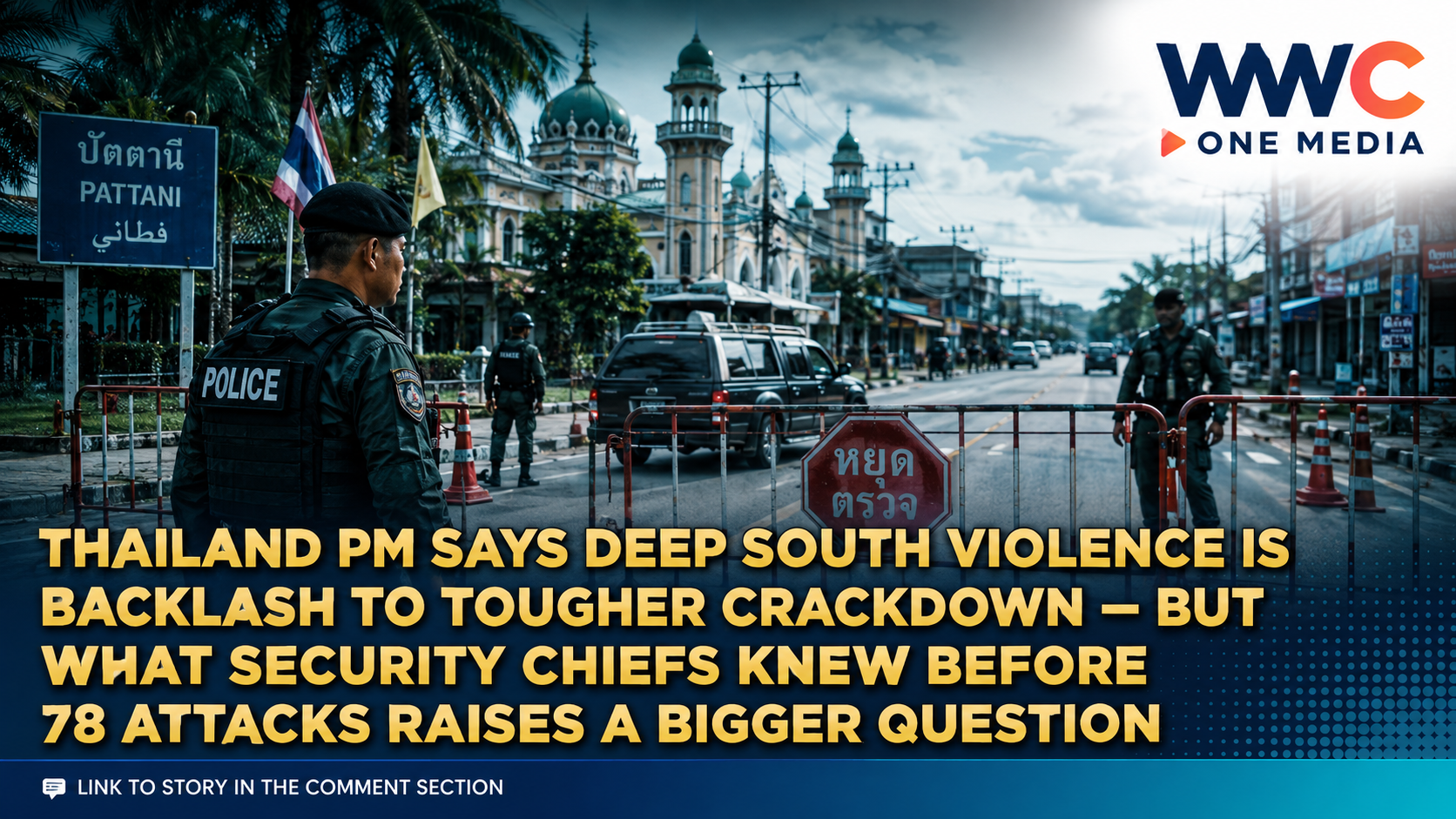
BANGKOK — Thailand’s government is linking the continuing violence in the country’s troubled Deep South to intensified law-enforcement operations, but a widening investigation — and revelations that security agencies had advance warnings before a massive wave of attacks — are raising difficult questions about what is driving the latest escalation and whether tougher security measures alone can contain it.
Prime Minister Anutin Charnvirakul said the continuing unrest in Thailand’s southern border provinces appeared to be a response to stronger enforcement against criminal and security networks operating in the region, according to a Bangkok Post report published Sunday.
The assessment echoes comments from senior Thai security officials following a major outbreak of coordinated violence beginning on the night of August 22.
But authorities have stopped short of declaring that every attack was carried out by the same organization or had the same motive.
National Security Council secretary-general Chatchai Bangchuad said investigators were examining several possibilities, including retaliation against intensified state operations, criminal activity, illegal businesses and local disputes.
That distinction is critical as Thailand tries to understand one of the most dramatic bursts of violence in its southern border region in recent years.
More Than 70 Incidents Across Thailand’s Deep South
Initial military reports recorded 51 incidents across Pattani, Yala and Narathiwat on the night of August 22, involving small bombs, arson attacks and damage to government and private property.
As authorities gathered reports from additional locations and incidents continued, the overall tally expanded.
Reuters subsequently reported at least 78 incidents across four provinces — Narathiwat, Yala, Pattani and Songkhla.
Government buildings, shops, vehicles, utility poles and other infrastructure were targeted. A convenience store in Pattani was burned, while an explosion damaged railway tracks in Narathiwat and disrupted train services.
At least three civilians were reported injured.
The relatively limited casualty count contrasted sharply with the scale and geographical coordination of the attacks, suggesting that demonstrating operational reach may have been as important to the perpetrators as causing casualties.
No organization immediately claimed responsibility.
The Barisan Revolusi Nasional Melayu Patani, or BRN, is widely regarded as the strongest separatist organization operating in the region and has been involved in intermittent negotiations with the Thai government. However, Thai authorities have not publicly established that the BRN was responsible for every recent incident.
Why Officials Believe the Crackdown May Have Triggered a Response
Thai security officials say the timing of the attacks may be significant.
Government operations against suspected militants, criminal networks, illegal drugs and other illicit activity have intensified in the southern provinces.
Chatchai said the latest unrest could represent retaliation against stronger government enforcement or an attempt by armed groups to demonstrate that they remain capable of operating despite increased pressure.
The security push followed several serious attacks earlier this year, including a July assault on a checkpoint in Narathiwat that killed five paramilitary rangers and wounded civilians.
Prime Minister Anutin has repeatedly taken a hard line on illegal weapons, narcotics, influential criminal groups and security threats while also calling for civilian protection and coordinated intelligence operations.
Yet the latest violence presents the government with a difficult equation: if stronger enforcement is disrupting armed or criminal networks, those networks may be responding with highly visible attacks designed to show that they have not been neutralized.
That does not necessarily mean enforcement caused the conflict. Thailand’s southern insurgency is more than two decades old and is rooted in far deeper historical and political grievances.
The Intelligence Question Thailand Cannot Ignore
Perhaps the most uncomfortable revelation came after the attacks.
Fourth Army Region commander Lt Gen Norathip Poinok acknowledged that security agencies had received warnings for nearly two months that attacks could occur.
Authorities reportedly had information indicating that government buildings, power infrastructure, convenience stores and commercial sites might be targeted.
What they lacked was sufficiently precise intelligence about exact locations and timing to prevent the coordinated attacks.
Senior officials have since acknowledged shortcomings in threat assessment and interception.
That creates an obvious question for the government: If security agencies knew a major operation might be coming, how were attackers still able to strike dozens of locations across several provinces within hours?
The government has promised to reassess intelligence gathering, information sharing and security coordination.
The issue matters because Anutin’s own Deep South policy has emphasized better intelligence.
In July, the government outlined a strategy calling for security agencies to integrate intelligence, improve public trust, uphold the rule of law and human rights, and avoid creating conditions that could generate further conflict.
The events of August will now test whether that strategy works outside policy documents.
A Conflict That Has Already Killed More Than 7,800 People
Thailand’s Deep South conflict is not new.
Violence intensified dramatically in 2004 in Pattani, Yala and Narathiwat — Muslim-majority provinces along Thailand’s border with Malaysia with a distinct Malay cultural and historical identity.
More than 7,800 people have been killed during the past 22 years, according to figures cited by AP and Reuters.
Separatist movements have operated in the region for decades, while local grievances have included questions of political representation, cultural identity, language, governance and the conduct of state security forces.
The BRN has emerged as the most significant armed separatist organization involved in the conflict.
Malaysia has helped facilitate peace negotiations between Bangkok and insurgent representatives since 2013, but repeated rounds of talks have failed to produce a lasting settlement.
Just days before the latest attacks, Thailand’s new chief peace negotiator signaled that Bangkok wanted to rethink that process.
Reuters reported that negotiator Thanut Suvarnananda was seeking greater focus on political grievances and governance arrangements rather than simply exchanging concessions for reductions in violence.
Possible discussions surrounding greater local participation, forms of self-administration and amnesty have been raised as part of efforts to break the stalemate.
The renewed violence could make those negotiations considerably more difficult — or increase pressure on both sides to return to them.
Security Versus Political Settlement
The latest attacks expose the central dilemma facing Bangkok.
More aggressive enforcement may disrupt militant financing, criminal activity and operational networks.
But security pressure alone has not ended an insurgency that has survived multiple Thai governments, military operations and political crises.
Reuters reporting from the region this week described communities still living with fear and deep mistrust after more than two decades of conflict.
For ordinary residents, the debate over whether the latest violence represents insurgent retaliation, criminal resistance or political signaling is secondary to a more immediate concern: whether they can travel, work and raise their families without being caught between armed groups and security operations.
Thailand’s government now faces two simultaneous challenges.
It must identify and prosecute those responsible for the attacks while protecting civilians and critical infrastructure.
At the same time, it must prevent its response from worsening the grievances that have allowed the conflict to survive for more than two decades.
Anutin’s argument that intensified enforcement is provoking resistance may ultimately prove correct.
But if stronger enforcement is followed by stronger retaliation, Thailand faces an even more difficult question:
Can Bangkok break that cycle through security operations alone — or will the latest violence force the government to make a breakthrough at the negotiating table?