
The Designer Behind Some of Asia’s Most Beautiful Hotels Reveals What Luxury Is Really Becoming — And It’s Not What You Think

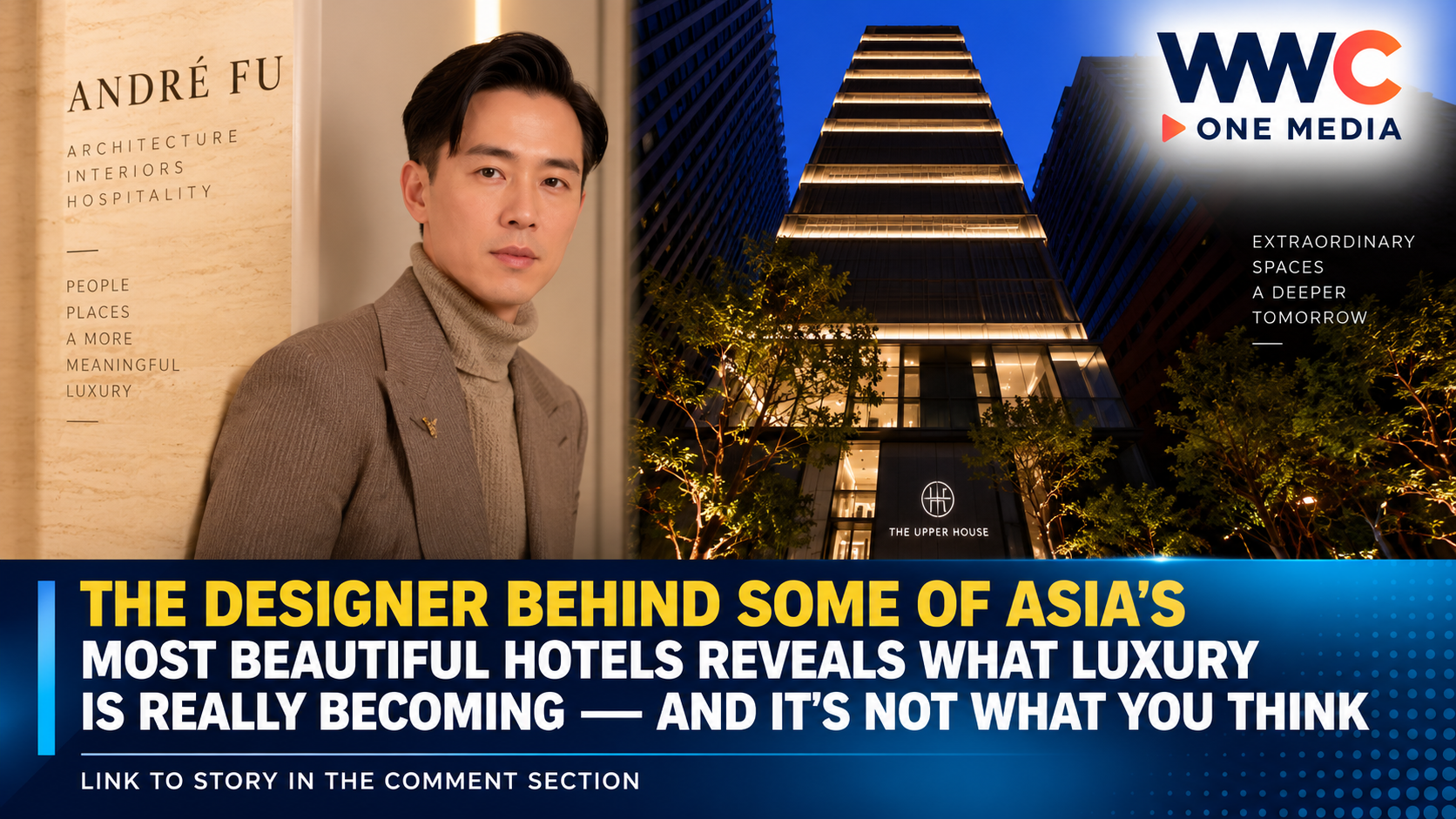
SINGAPORE/HONG KONG — Luxury hotels are often designed to make an immediate impression. André Fu wants guests to feel something deeper.
For the Hong Kong-born architect and interior designer, the future of luxury hospitality is increasingly less about spectacle and more about comfort, atmosphere, authenticity and a strong sense of place.
Fu has become one of Asia's most recognizable names in hospitality design, with a portfolio spanning Hong Kong, Singapore, Bangkok, Kyoto, London and other international destinations.
His work includes The Upper House and The St. Regis Hong Kong, The Fullerton Bay Hotel and Andaz Singapore, Waldorf Astoria Bangkok, Hotel The Mitsui Kyoto and The Berkeley in London.
But Fu's influence goes beyond individual hotels.
His design philosophy has helped reinforce a broader shift in Asian luxury hospitality: away from interiors that simply communicate wealth and toward spaces designed to feel residential, intimate and emotionally connected to their surroundings.
From a three-person studio to global recognition
Fu's journey is remarkable partly because hotel design was not originally his specialty.
In 2005, while Fu was still a relatively young designer running a studio with only three people, Swire Properties executive Keith Kerr noticed his work and invited him to discuss a possible project.
That opportunity became The Upper House, which opened in Hong Kong in 2009.
Fu has recalled that he had no previous hotel experience when he received the commission. The brief was remarkably simple: “calm” and “comfort.”
The result helped establish a new kind of Asian luxury aesthetic—one that favored proportion, natural materials, restraint and a residential sense of comfort rather than overt grandeur.
The Upper House would eventually become one of Fu's defining projects and a reference point for his approach to hospitality design.
Singapore became another important chapter
Fu's influence soon extended beyond Hong Kong.
In Singapore, he designed interiors for The Fullerton Bay Hotel and Andaz Singapore, while also contributing to Capella Singapore through the design of its Chinese restaurant Cassia and a later refurbishment of the resort's suites and villas.
His work at Capella illustrates an important part of his philosophy: new luxury does not necessarily mean replacing everything that came before.
When Fu refurbished Capella Singapore's rooms and villas, the underlying structure and layout were retained. Instead, he introduced updated furnishings, lighting, colors and materials while respecting the original design created by the late Indonesian designer Jaya Ibrahim.
The approach produced a more contemporary environment without erasing the character that made the resort distinctive.
His definition of luxury is changing
Fu's philosophy is particularly relevant as travelers become more sophisticated about design.
In a CNA Luxury interview, he described his approach as “relaxed luxury” and emphasized the importance of designing around how people actually experience a space.
That means considering seemingly ordinary details: where someone naturally sits, how they move through a room, where they switch on a light and how comfortable they feel once they arrive.
For Fu, a hotel is therefore more than a visually impressive building.
It becomes part of the travel experience itself.
He has argued that hotels can function as a visitor's first and last window into a city—making design an important tool for communicating a destination's culture, atmosphere and sense of place.
Kyoto showed how that philosophy can travel
One of Fu's most notable international projects is Hotel The Mitsui Kyoto, located opposite Nijo Castle.
The property combines contemporary architecture and interiors with elements drawn from Kyoto's history and craftsmanship.
Condé Nast Traveler notes that Fu's interiors incorporate subtle references to Japanese culture while maintaining a contemporary aesthetic. The hotel also preserves the historic Kajiimiya Gate associated with the former Mitsui residence on the site.
That balance is central to Fu's design philosophy.
Rather than reproducing obvious cultural symbols, his work tends to reinterpret history through materials, proportions, textures, craftsmanship and atmosphere.
In a 2025 interview, Fu explained that he tries to create environments that are genuine and specific to their users rather than spaces designed merely as visual spectacles. He also described the hotel as essentially a temporary home.
The St. Regis Hong Kong offered another interpretation
At The St. Regis Hong Kong, Fu took a different route.
The design was conceived as a contemporary mansion combining the heritage of the St. Regis brand with Fu's own memories of growing up in Hong Kong.
According to the South China Morning Post, Fu deliberately avoided relying on stereotypical representations of Hong Kong. Instead, he combined Western elements such as timber paneling with Eastern references including jade lacquer, creating an environment that felt personal rather than themed.
That distinction is important.
Fu doesn't appear to believe that a hotel in Asia needs to look traditionally Asian to feel connected to Asia.
The cultural references can be quieter—and arguably more powerful—when they are woven into the architecture rather than simply displayed as decoration.
Twenty-five years later, the philosophy has become a global signature
Fu is now celebrating 25 years of his eponymous studio, marking a major milestone in a career that began with that unlikely opportunity to design The Upper House.
Tatler Asia reports that the anniversary has been accompanied by an exhibition of his Upper House sketches, a talk at the Hong Kong Design Centre and the release of his third monograph, André Fu: A Designer's Vision, published by Assouline.
The book brings together 20 recent hospitality and residential projects across Europe and Asia, including Claridge's in London, Villa La Coste in Provence and Capella Taipei.
Fu's portfolio now extends well beyond the cities where his career began. His studio's projects include hotels and hospitality spaces in London, Kyoto, Seoul, Bangkok and other international destinations.
Wallpaper* recently included Fu among its 20 influential contemporary interior designers, describing his work as a cross-cultural dialogue between Eastern and Western design traditions.
What comes next could be even more interesting
Perhaps the most revealing part of Fu's career is that his work has evolved without abandoning its central idea.
The details change from project to project.
Hong Kong might inspire one language. Kyoto another. Singapore another.
Yet the underlying principles remain remarkably consistent: comfort, restraint, craftsmanship, cultural sensitivity and a sense of place.
That may explain why his interiors continue to resonate as the meaning of luxury changes.
Today's high-end traveler can already buy almost anything.
What is increasingly difficult to buy is a feeling of belonging somewhere—even temporarily.
And that may be the space André Fu has spent the past two decades learning how to design.
WWC ONE MEDIA M.J.E